

 4.7
4.7
What Is a Tugger Machine? Meaning, Types and How One Works
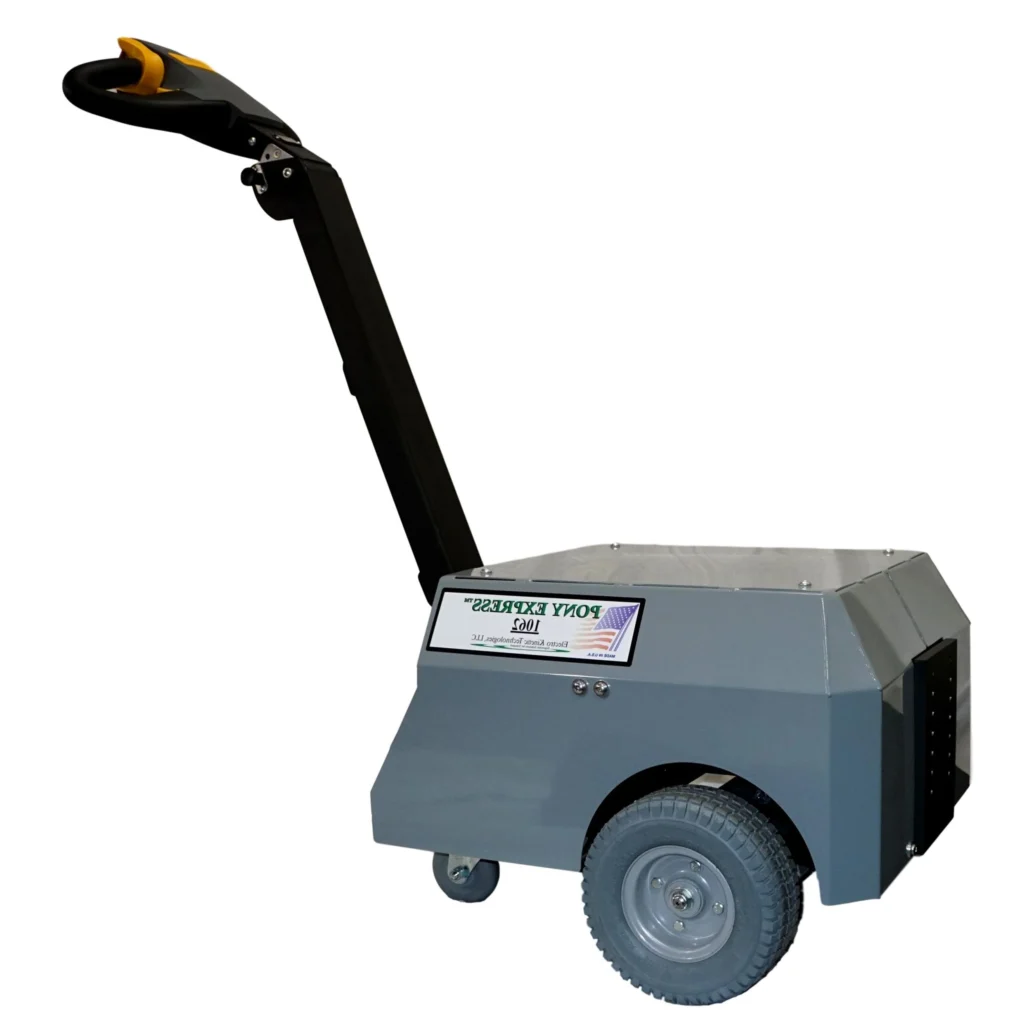
An electric tugger is a compact battery-powered machine that one worker walks behind to tow a wheeled cart, so the person steers the load instead of pushing or pulling its full weight by hand. It does not lift or carry anything. It hooks onto a cart that already rolls, then its motor does the work that used to take two or three people leaning into a heavy dolly. If you have ever watched a nurse fight a loaded linen bin down a long corridor, or a warehouse picker shove a parts cart across a slick floor, you have seen the exact job a tugger removes from human muscle.
What the machine is, how the hitch and drive actually move a cart, where the real benefits and tradeoffs land, and how to size one by load weight all come down to matching the tugger to the right rung of the capacity ladder. We sell the full Pony Express tugger range, so every spec comes straight off the verified product sheets, not a brochure rounding.
Last updated June 2026.
Our picks at a glance
- Top Pick
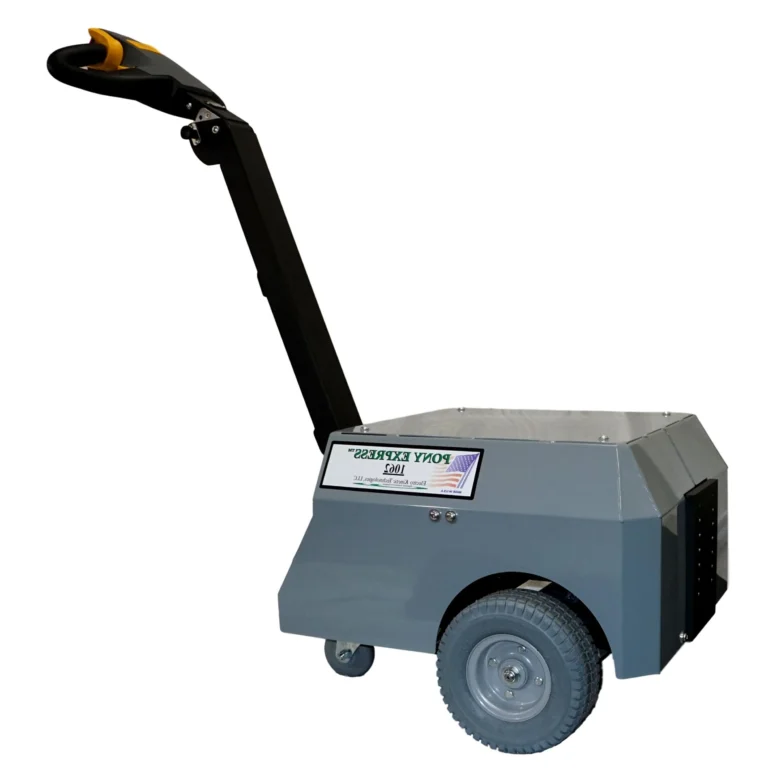 Pony Express 1062 Electric Powered Tugger
- Weight Capacity2000 lbs. on flat surface
- Incline RatingHolding brake, reduced pull on a slope
- Length25"
$5,399View details 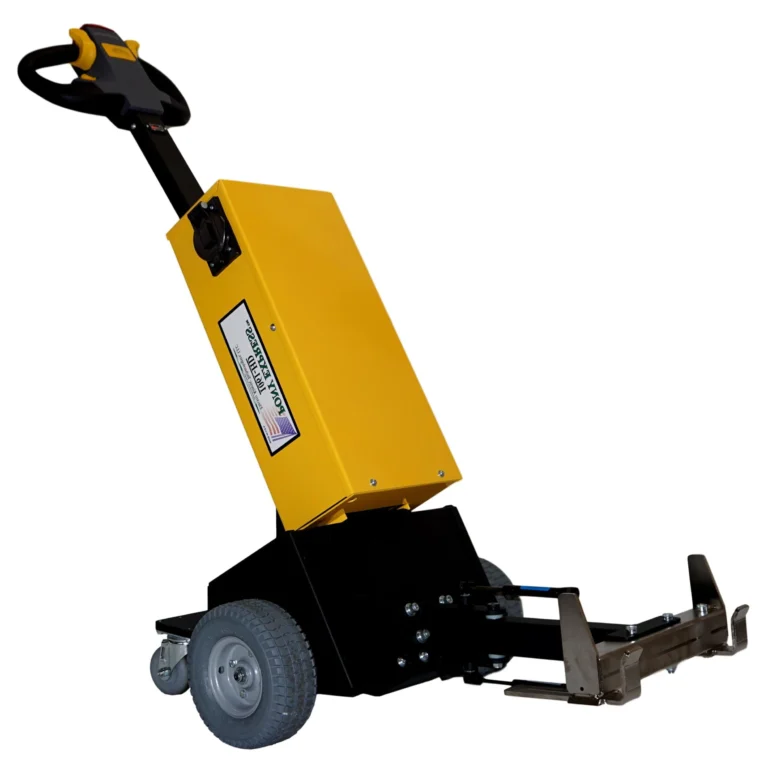 Pony Express 1061-HD Electric Powered Tugger
- Weight Capacity2000 lbs. on flat surface
- Incline RatingHolding brake, reduced pull on a slope
- Length39" to 54" adjustable
$4,752View details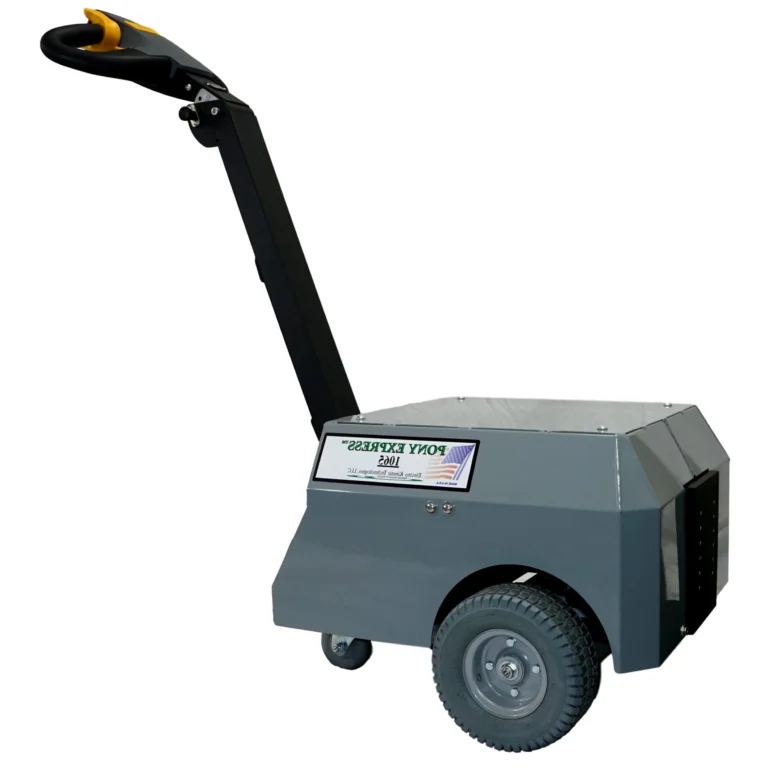 Pony Express 1065 Electric Powered Tugger for Loads up to 5000 lbs
- Weight Capacity5000 lbs. on flat surface
- Incline RatingHolding brake, reduced pull on a slope
- Length25"
$6,279View details- Pony Express 1065-XHD Electric Powered Tugger for Loads up to 7500 lbs
- Weight Capacity7500 lbs. on flat surface
- Incline RatingHolding brake, reduced pull on a slope
- Length25"
$8,949View details 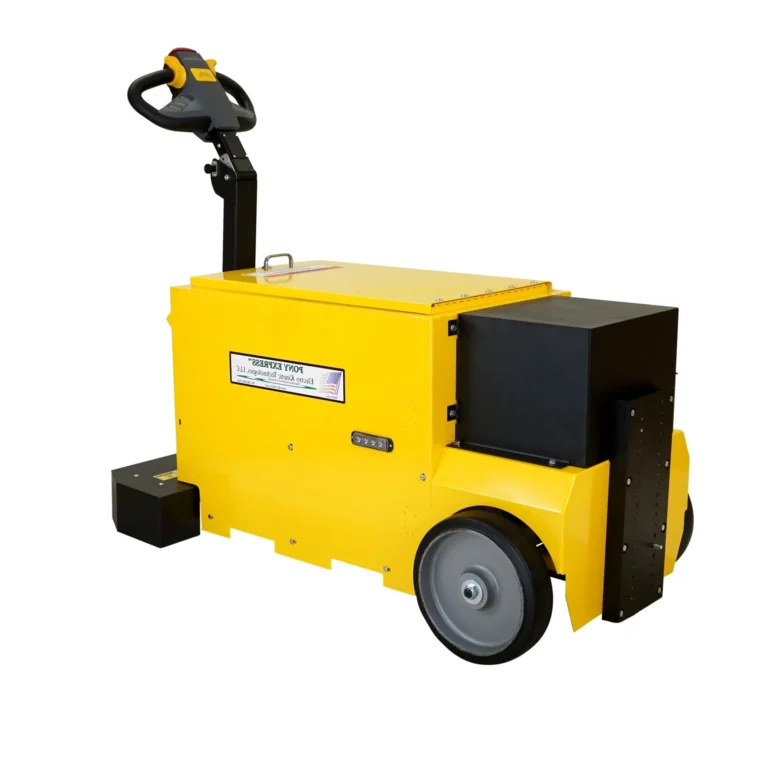 Pony Express Electric Powered AC Tugger 25K+
- Weight Capacity Casters25,000 lbs.
- Weight Capacity Rails100,000 lbs.
- Product Length52"
$20,195View details
What is an electric tugger?
An electric tugger is a battery powered tugger that an operator walks behind to tow a wheeled cart, so the person guides the load rather than pushing or pulling its full weight. The machine moves carts that already have wheels. It does not lift the load, it does not carry it, and it is not a forklift. Think of it as a small motorized "horse" that latches to the front of a cart and pulls.
You will see the same machine sold under a handful of names. Electric tug, cart mover, pedestrian tugger, walk-behind tugger, pedestrian operated electric tugger, battery powered tugger. They all describe one thing, a person-height handle on a small drive unit that couples to a cart and tows it at walking pace.
These machines earn their keep wherever loaded carts move often. Hospitals run them down corridors with linen bins and central sterile carts. Warehouses tow picking carts and parts dollies. Labs move sample and equipment carts. Hotels and resorts haul housekeeping and laundry bins. Manufacturing plants deliver parts to the line and shift heavy dies and fixtures. The common thread in every case is a wheeled cart that one person used to wrestle by hand.
That is the core reason the category exists. A loaded cart that needed a two or three person push now needs one operator and a thumb on a speed wheel. The dead weight comes off backs and shoulders, and the move gets faster and more repeatable at the same time.
How does an electric tugger work?
An electric tugger works in a simple sequence. You latch the cart to the tugger's hitch, a battery-driven motor on a center wheel pulls the load at walking speed, and a dead-man control stops the unit the instant you let go. Steering and speed both come from an ergonomic handle, so one operator runs the whole thing standing up and walking beside the load.
The drive is the heart of it. A high-torque 24V DC motor sits on a center wheel fitted with foam-filled non-marking tires. Those tires matter more than they sound. They grip smooth indoor floors, they never go flat, and they will not leave black scuff marks on a hospital or showroom floor. On the 48V AC flagship the same idea scales up to a 1.7 kW transaxle, but the principle is identical, one driven wheel doing the pulling.
Control lives in the handle. A variable speed thumb wheel runs two ranges, 0 to 1.5 mph on the low setting for tight spaces and 0 to 3.0 mph on the high setting for open runs, both forward and reverse. There is no clutch, no foot pedal, no gear to learn. You roll the thumb wheel and the tugger matches your pace.
The headline safety mechanism is the dead-man control. The Pony Express spec sheet states it plainly, the unit comes to a controlled stop when the operator removes their hands from the controls. Let go for any reason and the machine stops itself, which is exactly what you want when a loaded cart is moving near people.
Braking is layered. Regenerative braking slows the unit on the move and feeds a little energy back to the battery. An automatic electromagnetic holding brake then parks the load so it will not roll on a slope when the operator steps away. Power comes from a deep cycle AGM or lithium battery with an onboard or external UL and cUL listed smart charger, and the Pony Express family is rated for roughly 8 hours of operation per charge.
- 1. HitchLatch the cartLockable adjustable hooks couple the cart to the tugger so the two move as one unit
- 2. Drive24V or 48V motorA high-torque motor on a center wheel pulls the load on foam-filled non-marking tires
- 3. Control0 to 3 mphVariable thumb-wheel speed in dual ranges 0 to 1.5 mph low and 0 to 3 mph high, forward and reverse
- 4. BrakeDead-man + holdingLets go and it stops, regenerative braking on the move, automatic holding brake parks the load on a slope
Raphael's rule of thumb Before anyone trusts a tugger near patients or product, I tell facilities to do one thing on day one. Load the heaviest cart you actually move, let the operator take their hands off the handle mid-run, and watch it stop. Seeing the dead-man brake catch a real load in front of you builds more confidence in five seconds than any spec line on a page.
What does the hitch actually do?
The hitch is the steel coupling that locks the cart to the tugger so the two move as one unit, and swapping the hitch is how the same tugger adapts to different cart styles. The standard Pony Express hitch uses lockable adjustable hooks, gas shocks, and corrosion-resistant nickel plating. The hooks grab the cart, the gas shocks take the slack out of the connection, and the plating keeps it from rusting in a wash-down or cold-store environment.
A wide portfolio of hitch options is what lets one tugger tow many cart types. That is the part most first-time buyers miss. You are not buying a machine locked to one cart, you are buying a drive unit plus a hitch chosen for your fleet of carts.
The clearest example is the purpose-built laundry model. The Pony Express 1065-LS uses a quick-connect bin hitch that needs no modification to existing laundry bins, and an optional bin-to-bin hitch lets it move several bins in a short train without them colliding. Same drive platform, a hitch built for the job, and a hospital or hotel laundry that no longer pushes 5000 lb of wet linen by hand.
Pony Express electric tuggers by load class
- #1Best overall
Pony Express 1062 Electric Powered Tugger
The clearest entry-point machine and our pick for a first-time buyer. The smallest body in the family at 25 in long and 24 in wide, it carries 2000 lbs on a flat surface with a high-torque 24V DC center-wheel drive and lands in the hospital and warehouse cart-moving sweet spot most buyers fall into.
See price & details- Pros
- 2000 lbs on a flat surface, the compact-class workhorse rating, with dual 0 to 1.5 and 0 to 3.0 mph speeds
- Smallest footprint in the lineup at 25 in long, 24 in wide, fits tight storerooms
- 35 Ah AGM standard with an optional 70 Ah AGM package for longer shifts
- Made in the USA, in stock, roughly 8 hours of operation per charge
- Cons
- 2000 lb ceiling means heavier parts carts need a 1065 or above
- AGM recharge is about 4 hours, slower than the lithium siblings
- #2
Pony Express 1061-HD Electric Powered Tugger
The lowest-cost rung on the ladder and the budget compact pick. Same 2000 lb AGM platform as the 1062, with an adjustable 39 to 54 in length that reaches longer carts, so it is a clean entry point for a facility testing whether a tugger fits its workflow.
See price & details- Pros
- 2000 lbs on a flat surface, same dual-speed control as the rest of the family
- Lowest-priced rung in the family at $4,752
- Adjustable 39 to 54 in length suits longer carts
- 35 Ah AGM Deep Cycle, roughly 8 hours of operation per charge
- Cons
- Longer adjustable body is less nimble than the 25 in 1062 in tight aisles
- 35 Ah AGM only, no optional 70 Ah package like the 1062
- #3
Pony Express 1065 Electric Powered Tugger for Loads up to 5000 lbs
The mid-capacity step that bridges the compact and heavy-duty halves of the range. The same 24V DC platform scales to 5000 lbs on a flat surface on a 70 Ah AGM battery, in the same compact 25 in by 24 in body, so it handles parts carts and heavier industrial loads without growing the footprint.
See price & details- Pros
- 5000 lbs on a flat surface in a compact 25 in by 24 in body
- 70 Ah AGM battery, roughly 8 hours of operation per charge
- Same dual 0 to 1.5 and 0 to 3.0 mph speeds as the compact class
- Automatic holding brake keeps the load steady on a graded floor, with a reduced pull on a slope
- Cons
- Tops out at 5000 lb, heavier carts need the 6500 or 7500 lb rung
- Single AGM battery, no hot-swap lithium pack in this exact SKU
- #4
Pony Express 1065-XHD Electric Powered Tugger for Loads up to 7500 lbs
The top of the standard 24V DC range at 7500 lbs on a flat surface. It shows the heavy-duty end of the ladder before the jump to the AC flagship, keeping the same compact body, dual-speed control, and 70 Ah AGM battery while moving the heaviest loads the DC platform handles.
See price & details- Pros
- 7500 lbs on a flat surface, the most a 24V DC Pony Express tows
- Compact 25 in by 24 in body despite the high capacity
- 70 Ah AGM, roughly 8 hours of operation per charge
- Automatic holding brake keeps the load steady on a graded floor, with a reduced pull on a slope
- Cons
- Tops out the 24V DC platform at 7500 lb, extreme loads move to the AC flagship
- For loads in the high 5000s to low 6000s the 1065-HD at 6500 lb may be the better-fit rung
- #5
Pony Express Electric Powered AC Tugger 25K+
The top of the capacity ladder and the only AC machine in the family. A 48V AC Vector Power drive moves 25,000 lbs on casters and 100,000 lbs on rails, with a choice of 100 Ah AGM or 120 Ah lithium iron phosphate batteries and Bluetooth fleet monitoring. This is where the category tops out and why the AC drive exists.
See price & details- Pros
- 25,000 lbs on casters and 100,000 lbs on rails, the heaviest in the range
- 1.7 kW transaxle on AC Vector Power technology
- Choice of 100 Ah AGM or 120 Ah lithium iron phosphate batteries
- Bluetooth battery monitoring for fleet management
- Cons
- Larger 30 in body, wider than the compact 24 in DC machines
- No published degree incline rating
- Overkill for anything under heavy industrial and rail loads
What are the benefits of an electric tugger?
The main benefit of an electric tugger is taking the heavy push-pull force off a worker, which cuts the strain injuries that come from moving loaded carts by hand and lets one person do a job that used to take two or three. Injury reduction is the headline, and it is not a soft claim. Manual cart moving is a well-documented source of back and shoulder strain, and federal ergonomics guidance treats push and pull force as a real musculoskeletal hazard, not an afterthought. The OSHA ergonomics guidance and the CDC NIOSH manual material handling guidelines both flag pushing and pulling carts as a load on the body worth engineering out. A tugger engineers it out by replacing the human force with a motor.
Labor is the next benefit. One operator on a tugger replaces a multi-person manual push. In a hospital or a distribution center where the same cart route runs dozens of times a shift, that is real recovered hours, not a one-time saving.
Floor and product safety follow from the controlled speed. A tugger walks the load at 0 to 3 mph on non-marking foam-filled tires, which protects the floor and reduces the collisions you get when a heavy cart wobbles away from a hand-pusher. Regenerative and holding brakes keep the load under control on ramps and slopes, so a parked cart stays put instead of rolling.
Now the tradeoff worth naming. A tugger is a capital purchase, it needs charging downtime, and it needs a trained operator, so it pays off in facilities that move loaded carts over the floor every shift and not for a once-a-week haul that two people can handle in five minutes. If you move loaded carts constantly the machine earns its keep fast, and if you move them rarely it just sits on a charger. Take a clear look at how often you really make the move before you spend the money.
What is an electric tugger used for?
Electric tuggers are used anywhere wheeled carts move repeatedly across flat indoor floors, most often in hospitals, warehouses, labs, hotels, and manufacturing plants. The setting changes, the job does not. A cart that someone used to shove by hand now gets towed.
- Healthcare. Moving linen and laundry bins, supply carts, and central sterile processing carts down long hospital corridors. The Pony Express 1062 and the laundry-specific 1065-LS both land here.
- Warehouse and distribution. Towing picking carts and parts dollies, often in a short tugger-and-cart train so one operator delivers several carts in one trip.
- Hospitality. Hotel and resort laundry and housekeeping bins, where a battery powered tugger quietly moves heavy bins on non-marking tires without scuffing finished floors.
- Manufacturing. Line-side parts delivery and shifting heavy fixtures and dies between stations.
The common thread across all of them is the same three conditions, a smooth flat floor, a wheeled cart, and a move that happens often enough to justify the machine. Hit those three and a tugger fits. Miss any one of them and you should think twice.
How do you choose the right electric tugger size?
Choose an electric tugger by the loaded weight of your heaviest cart on a flat floor, then pick the rung of the capacity ladder that covers it with margin to spare. One spec decides almost everything here, Weight Capacity on a flat surface. Weigh the cart fully loaded. Do not guess and do not eyeball it, because guessing low is how you buy a machine that struggles on your real worst-case load.
The Pony Express ladder breaks into three classes.
- Compact class, 2000 lb. Pedestrian tuggers for linen carts, supply carts, and lighter dollies. The 1062 and the 1061-HD both sit here, rated 2000 lbs on a flat surface.
- Heavy-duty DC class, 5000 to 7500 lb. For parts carts, pallet dollies, and heavier industrial loads. The ladder runs the 1065 at 5000 lb, the 1065-HD at 6500 lb, and the 1065-XHD at 7500 lb, all on the same 24V DC platform with a 70 Ah AGM battery.
- AC flagship class, 25000 lb. A 48V AC machine for extreme loads, the AC Tugger 25K+, rated 25,000 lbs on casters and 100,000 lbs on rails.
Footprint matters too, not just capacity. The 1062 is a 25 in long, 24 in wide compact body that tucks into tight hospital storerooms. The 1061-HD trades a slightly larger 24.5 in width for an adjustable 39 to 54 in length that reaches longer carts. Pick the body that fits your aisles and your cart geometry, not just the weight rating.
Battery choice is the last decision. AGM is the affordable standard and what most buyers start on. Lithium adds hot-swap packs, a roughly 3 hour recharge, and a Bluetooth app to watch battery status from a phone. The 1061-HD Lithium is the compact lithium option if multi-shift uptime matters more than upfront price. If you are weighing AGM against lithium across a fleet, our guide to picking the right battery for a tugger or motorized cart walks through the math.
One caution buyers miss. The incline rating is not the flat-floor capacity. The DC models carry their rated weight on a flat surface, and on a graded floor an automatic holding brake keeps the load steady while the pull is reduced on a slope. If your route has a real ramp, size up and call us with the grade so we rate it properly. The AC 25K+ handles slopes its own way, because its AC Vector Power drive is specced differently.
Electric tugger comparison by load class
This table lines up five Pony Express pedestrian tuggers from the 2000 lb compact rung to the 25,000 lb AC flagship, so you can match a load weight to a machine at a glance. Read it as a ladder, find your loaded cart weight, then pick the first model that clears it with room to spare.
Pony Express electric tugger comparison by load class
| Tugger | Weight Capacity | Variable Speed Range | Battery | Range per charge | Incline Rating | Width |
|---|---|---|---|---|---|---|
| Pony Express 1061-HD | 2000 lbs. on flat surface | 0 to 1.5 mph low setting, 0 to 3.0 mph high setting | 35 Ah, AGM Deep Cycle | 8 hours of operation | Automatic holding brake, reduced pull on a slope | 24.5" |
| Pony Express 1062 | 2000 lbs. on flat surface | 0 to 1.5 mph low setting, 0 to 3.0 mph high setting | 35 Ah, AGM, 70 Ah AGM package optional | 8 hours of operation | Automatic holding brake, reduced pull on a slope | 24" |
| Pony Express 1065 (5000 lb) | 5000 lbs. on flat surface | 0 to 1.5 mph low setting, 0 to 3.0 mph high setting | 70 Ah, AGM | 8 hours of operation | Automatic holding brake, reduced pull on a slope | 24" |
| Pony Express 1065-XHD (7500 lb) | 7500 lbs. on flat surface | 0 to 1.5 mph low setting, 0 to 3.0 mph high setting | 70 Ah, AGM | 8 hours of operation | Automatic holding brake, reduced pull on a slope | 24" |
| Pony Express AC Tugger 25K+ | 25,000 lbs. on casters, 100,000 lbs. on rails | 0 to 1.5 mph low setting, 0 to 3.0 mph high setting | 48 VDC, 100 Ah AGM or 48 VDC, 120 Ah lithium iron phosphate | 8 hours of operation | AC Vector Power drive (no degree rating published) | 30" |
Two things stand out in that table. First, the variable speed range is identical at 0 to 3.0 mph across every single model, because a pedestrian tugger is built to match a person walking beside it, not to drive faster. Capacity climbs from 2000 to 25,000 lb, but the walking pace never changes. Second, the AC flagship is the odd one out at the top. It trades the compact 24 in width for AC Vector Power drive and a 30 in body, which is the cost of moving 25,000 lb on casters.
The table leaves out one heavy-duty rung to stay readable. Between the 5000 lb 1065 and the 7500 lb 1065-XHD sits the 1065-HD at 6500 lb, same 70 Ah AGM platform, for loads that fall in that gap. If your cart weighs in the high 5000s or low 6000s, that is your rung.
Which electric tugger should a first-time buyer start with?
Most first-time buyers land on a 2000 lb compact tugger like the Pony Express 1062, which is the smallest-footprint machine in the family and the clearest example of how a pedestrian tugger hitches and pulls a cart. At 25 in long and 24 in wide, it fits tight storerooms and corridors, carries 2000 lbs on a flat surface, runs the same dual 0 to 1.5 and 0 to 3.0 mph speeds as the rest of the family, and uses a 35 Ah AGM battery with an optional 70 Ah AGM package for longer shifts. Figure roughly 8 hours of operation per charge.
The 1062 sits squarely in the hospital and warehouse cart-moving sweet spot that most first buyers fall into, which is why it is our top pick for someone new to the category. It is made in the USA, in stock, and priced in the affordable middle of the ladder at $5,399, so it anchors the decision without scaring anyone off.
If budget is the deciding factor, look at the 1061-HD as the lower-cost compact sibling at $4,752. Same 2000 lb capacity and AGM platform, with an adjustable 39 to 54 in length that suits longer carts. It is the cheapest rung on the ladder and a clean entry point for a facility testing whether a tugger fits its workflow.
Pony Express electric tuggers by load class
- #1Best overall
Pony Express 1062 Electric Powered Tugger
The clearest entry-point machine and our pick for a first-time buyer. The smallest body in the family at 25 in long and 24 in wide, it carries 2000 lbs on a flat surface with a high-torque 24V DC center-wheel drive and lands in the hospital and warehouse cart-moving sweet spot most buyers fall into.
See price & details- Pros
- 2000 lbs on a flat surface, the compact-class workhorse rating, with dual 0 to 1.5 and 0 to 3.0 mph speeds
- Smallest footprint in the lineup at 25 in long, 24 in wide, fits tight storerooms
- 35 Ah AGM standard with an optional 70 Ah AGM package for longer shifts
- Made in the USA, in stock, roughly 8 hours of operation per charge
- Cons
- 2000 lb ceiling means heavier parts carts need a 1065 or above
- AGM recharge is about 4 hours, slower than the lithium siblings
- #2
Pony Express 1061-HD Electric Powered Tugger
The lowest-cost rung on the ladder and the budget compact pick. Same 2000 lb AGM platform as the 1062, with an adjustable 39 to 54 in length that reaches longer carts, so it is a clean entry point for a facility testing whether a tugger fits its workflow.
See price & details- Pros
- 2000 lbs on a flat surface, same dual-speed control as the rest of the family
- Lowest-priced rung in the family at $4,752
- Adjustable 39 to 54 in length suits longer carts
- 35 Ah AGM Deep Cycle, roughly 8 hours of operation per charge
- Cons
- Longer adjustable body is less nimble than the 25 in 1062 in tight aisles
- 35 Ah AGM only, no optional 70 Ah package like the 1062
- #3
Pony Express 1065 Electric Powered Tugger for Loads up to 5000 lbs
The mid-capacity step that bridges the compact and heavy-duty halves of the range. The same 24V DC platform scales to 5000 lbs on a flat surface on a 70 Ah AGM battery, in the same compact 25 in by 24 in body, so it handles parts carts and heavier industrial loads without growing the footprint.
See price & details- Pros
- 5000 lbs on a flat surface in a compact 25 in by 24 in body
- 70 Ah AGM battery, roughly 8 hours of operation per charge
- Same dual 0 to 1.5 and 0 to 3.0 mph speeds as the compact class
- Automatic holding brake keeps the load steady on a graded floor, with a reduced pull on a slope
- Cons
- Tops out at 5000 lb, heavier carts need the 6500 or 7500 lb rung
- Single AGM battery, no hot-swap lithium pack in this exact SKU
- #4
Pony Express 1065-XHD Electric Powered Tugger for Loads up to 7500 lbs
The top of the standard 24V DC range at 7500 lbs on a flat surface. It shows the heavy-duty end of the ladder before the jump to the AC flagship, keeping the same compact body, dual-speed control, and 70 Ah AGM battery while moving the heaviest loads the DC platform handles.
See price & details- Pros
- 7500 lbs on a flat surface, the most a 24V DC Pony Express tows
- Compact 25 in by 24 in body despite the high capacity
- 70 Ah AGM, roughly 8 hours of operation per charge
- Automatic holding brake keeps the load steady on a graded floor, with a reduced pull on a slope
- Cons
- Tops out the 24V DC platform at 7500 lb, extreme loads move to the AC flagship
- For loads in the high 5000s to low 6000s the 1065-HD at 6500 lb may be the better-fit rung
- #5
Pony Express Electric Powered AC Tugger 25K+
The top of the capacity ladder and the only AC machine in the family. A 48V AC Vector Power drive moves 25,000 lbs on casters and 100,000 lbs on rails, with a choice of 100 Ah AGM or 120 Ah lithium iron phosphate batteries and Bluetooth fleet monitoring. This is where the category tops out and why the AC drive exists.
See price & details- Pros
- 25,000 lbs on casters and 100,000 lbs on rails, the heaviest in the range
- 1.7 kW transaxle on AC Vector Power technology
- Choice of 100 Ah AGM or 120 Ah lithium iron phosphate batteries
- Bluetooth battery monitoring for fleet management
- Cons
- Larger 30 in body, wider than the compact 24 in DC machines
- No published degree incline rating
- Overkill for anything under heavy industrial and rail loads
Where to go next
Once you know your cart weight and battery preference, the next step is comparing prices and models inside the right capacity class. Start by browsing the full electric tugger range to see every model side by side.
If you are sizing a lighter load, the compact tuggers for lighter carts up to 2000 lb sub-collection narrows it down fast. For 5000 lb and up, go straight to the heavy-duty tuggers for 5000 lb loads and above. From there, our companion guides cover the next questions, what an electric tugger really costs by load class and how to match a tugger to your exact load weight.
Frequently asked questions
What is an electric tugger used for?
An electric tugger is used to tow wheeled carts across flat indoor floors so one worker moves a load that used to take two or three people to push by hand. The most common settings are hospitals (linen bins, supply carts, central sterile carts), warehouses and distribution centers (picking carts and parts dollies), labs, hotels and resorts (laundry and housekeeping bins), and manufacturing plants (line-side parts delivery and heavy dies). The machine does not lift or carry anything, it pulls a cart that already rolls.
How does an electric tugger work?
You latch the cart to the tugger's hitch, then a battery-driven motor on a center wheel pulls the load at walking speed while the operator steers and sets speed from an ergonomic handle. A variable thumb wheel runs two ranges, 0 to 1.5 mph low and 0 to 3.0 mph high, forward and reverse. A dead-man control stops the unit the instant the operator removes their hands, regenerative braking slows it on the move, and an automatic electromagnetic holding brake parks the load on a slope.
What is a pedestrian operated electric tugger?
A pedestrian operated electric tugger is a walk-behind machine, the operator stands and walks beside it rather than riding on it. The whole Pony Express family is pedestrian operated, which is why every model tops out at 0 to 3.0 mph, the speed of a person walking next to the load. You will also see the same machine called an electric tug, cart mover, walk-behind tugger, or battery powered tugger.
How fast does an electric tugger go?
A pedestrian electric tugger runs two speed ranges, 0 to 1.5 mph on the low setting for tight spaces and 0 to 3.0 mph on the high setting for open runs, both forward and reverse. The speed is identical across the entire Pony Express ladder from the 2000 lb compact 1062 to the 25,000 lb AC flagship, because the machine is built to match a walking operator, not to drive faster.
How much weight can an electric tugger pull?
It depends on the model. The Pony Express ladder runs from 2000 lbs on a flat surface for the compact 1062 and 1061-HD, up through 5000, 6500, and 7500 lbs on the heavy-duty 24V DC machines, to the 48V AC Tugger 25K+ rated 25,000 lbs on casters and 100,000 lbs on rails. Size the tugger by the fully loaded weight of your heaviest cart on a flat floor, then pick the rung that clears it with margin. Note that a slope reduces the pull, and an automatic holding brake keeps the load steady on a graded floor.
How long does an electric tugger battery last per charge?
The Pony Express tuggers are rated for roughly 8 hours of operation per charge. AGM models recharge in about 4 hours from an onboard UL, cUL, CE listed smart charger. The lithium option, like the 1061-HD Lithium, uses a hot-swappable pack that recharges in about 3 hours and reports battery status to a phone over Bluetooth, which suits multi-shift operations that cannot wait on a charge.