

 4.7
4.7
How to Choose an Electric Tugger by Load Capacity
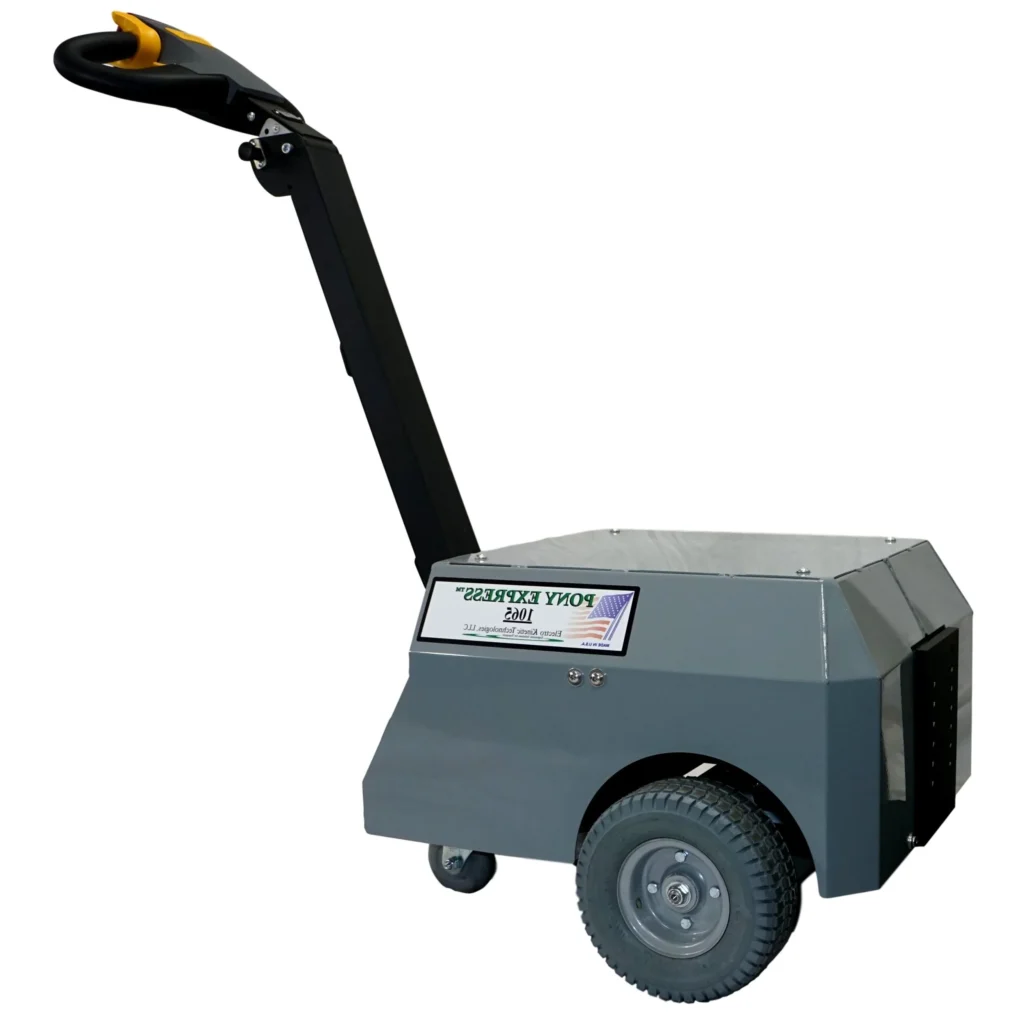
How to choose an electric tugger by load capacity comes down to one number you can measure on your own floor, the loaded weight of your heaviest cart. Get that number right and the rest of the choice falls into place. Guess it low and you buy a machine that strains on the one cart you most needed it to move. Size it correctly and one walk-behind tugger replaces the daily strain of pushing thousands of pounds by hand.
The full Pony Express capacity ladder runs from the 2,000 lb compact units up to the 25,000 lb AC flagship, and reading your load weight into the right rung is the whole job. Every spec comes straight off the verified product sheets, so the numbers match what ships to your dock. The fundamentals of what an electric tugger is and how it works are worth a read before you size one.
Last updated June 2026.
Our picks at a glance
- Most Affordable
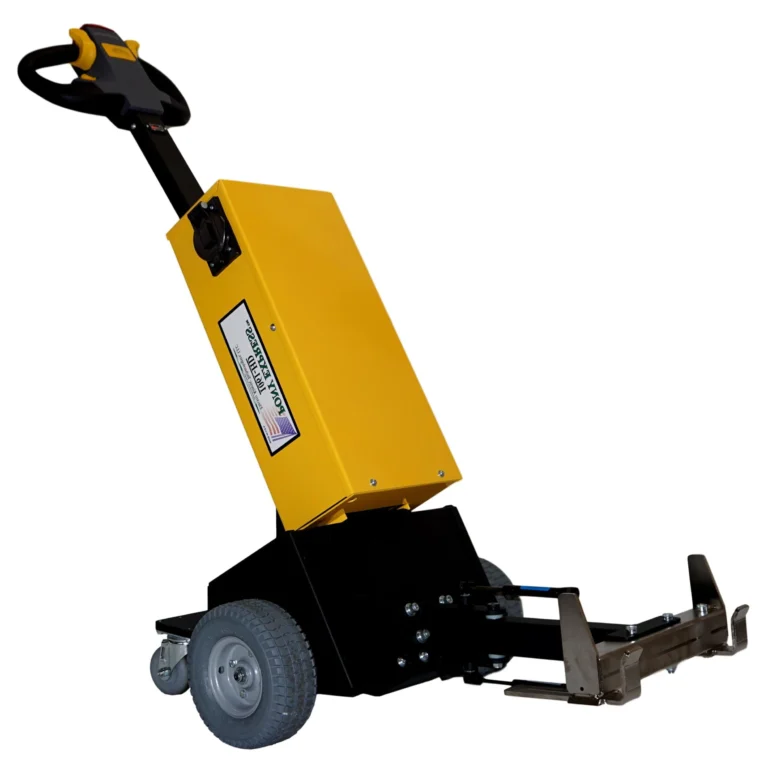 Pony Express 1061-HD Electric Powered Tugger
- Weight Capacity2000 lbs. on flat surface
- Incline RatingAutomatic holding brake, reduced load on a slope
- Variable Speed Range0 to 1.5 mph low setting, 0 to 3.0 mph high setting
$4,752View details - Pony Express 1061-HD Lithium Electric Powered Tugger
- Weight Capacity2000 lbs. on flat surface
- Incline RatingContact Facility
- Variable Speed Range0 to 1.5 mph low setting, 0 to 3.0 mph high setting
$7,199View details 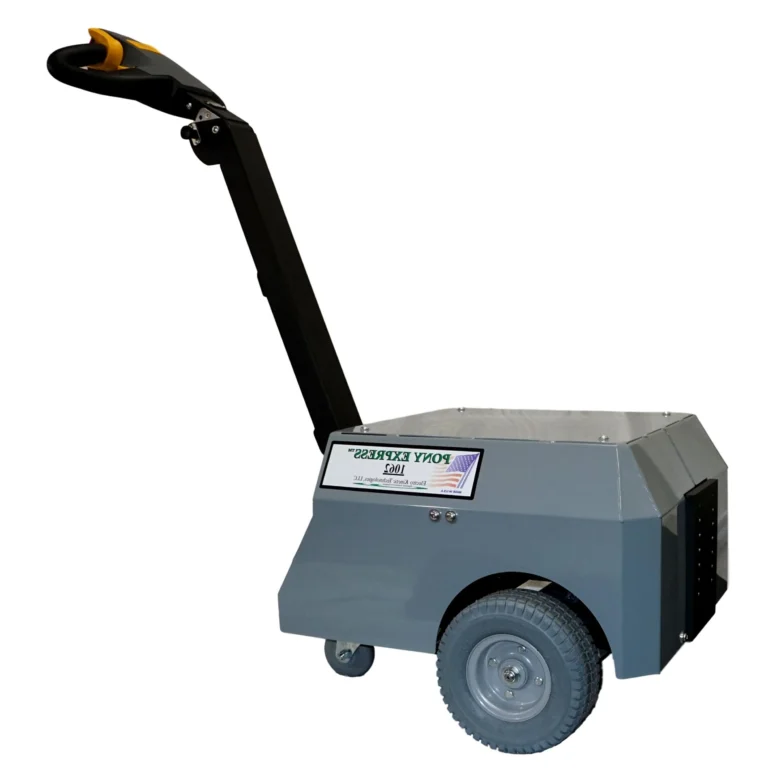 Pony Express 1062 Electric Powered Tugger$5,399View details
How to choose an electric tugger by load capacity in one pass
Choose an electric tugger by load capacity in three steps. Weigh the heaviest single cart you tow on a flat floor, add the cart's own tare weight to whatever it carries, then pick the nearest rated tier at or above that total so the tugger never runs at its ceiling. That last part matters. A machine run at its exact rating every shift wears faster than one carrying margin, so size up rather than dead-on.
Every rating here is a flat-surface tow rating. It is not a lift rating, because a tugger pulls a rolling cart instead of hoisting deadweight, and it is not an incline rating, because a ramp de-rates the number. Keep that frame in mind as you read each tier.
The in-stock ladder runs five rungs. A 2,000 lb compact tier for light cart trains, a 5,000 lb mid tier, a 6,500 lb and a 7,500 lb heavy tier, then a 25,000 lb AC flagship for extreme loads. When the right tier is not obvious, the 5,000 lb Pony Express 1065 covers the load most facilities actually run, which makes it the safe default. Where your number lands on that ladder, and why, comes down to the loaded weight of your heaviest cart.
What load weight actually means for a tugger rating
A tugger capacity rating is the total rolling weight the machine can tow on a flat, hard floor, so you size against the cart plus everything on it, not the payload alone. The rating measures tractive effort, the pull needed to overcome rolling resistance and get a wheeled load moving and keep it moving. It says nothing about lifting, because a tugger never lifts. It hitches to a cart that already rolls and pulls.
The math is simple once you have a scale. Take the cart's tare weight, add the payload, and that sum is the number you match to a tier. A bin train adds every linked cart and its contents to the total, so a string of three loaded carts is sized as one combined weight, not three separate ones. People miss that on cart trains and undersize the machine.
Flat-surface is the load-bearing word on every spec line. All four Pony Express DC ratings, 2,000, 5,000, 6,500 and 7,500 lb, are stated on a flat surface. The DC units use an automatic holding brake that steadies the load on a graded floor, and they pull a reduced load on a slope rather than the full flat-floor number uphill. If your route has a real ramp, size above your flat-floor figure and call us with the grade so we rate it properly.
Floor condition and tires shape the effort too. The whole Pony Express line rolls on foam-filled, non-marking drive wheels that never go flat and leave no scuff marks on finished floors, so that variable stays constant across every tier. A rougher floor or a worn cart caster raises the pull a given load needs, which is another reason to keep headroom above your measured weight.
The capacity ladder from 2,000 lb to 25,000 lb
The in-stock electric tugger ladder runs in five rungs, a 2,000 lb compact tier, a 5,000 lb mid tier, a 6,500 lb and a 7,500 lb heavy tier, then a 25,000 lb AC flagship, all on a similar footprint until the top rung. Read it as a ladder, find your loaded weight, and the rung that clears it is your machine.
The table below lines up the DC line against the AC flagship. Notice what changes and what does not. Weight Capacity climbs from 2,000 lb to 25,000 lb, but the variable speed range is identical across every model at 0 to 3.0 mph on the high setting, because a walk-behind tugger is built to match a person walking beside it. Battery and runtime stay constant across the DC units too. Load weight is the axis that drives the tier choice, not speed or runtime.
Footprint barely moves either. The DC units sit between 24 and 24.5 inches wide, so stepping up a tier rarely costs you aisle clearance. The one exception is the AC 25K+ at 30 inches wide. If space is your real constraint rather than weight, read our guide to how to choose an electric tugger for narrow aisles and tight spaces alongside this one.
Pony Express electric tugger capacity ladder, verified specs
| Model | Weight Capacity | Incline Rating | Variable Speed Range | Battery | Range per charge | Width |
|---|---|---|---|---|---|---|
| Pony Express 1061-HD | 2000 lbs. on flat surface | Automatic holding brake, reduced load on a slope | 0 to 1.5 mph low setting, 0 to 3.0 mph high setting | 35 Ah, AGM Deep Cycle | 8 hours of operation | 24.5" |
| Pony Express 1061-HD Lithium | 2000 lbs. on flat surface | Contact Facility | 0 to 1.5 mph low setting, 0 to 3.0 mph high setting | 40 Ah, lithium iron phosphate, hot swappable | 8 hours of operation | 24.5" |
| Pony Express 1065 | 5000 lbs. on flat surface | Automatic holding brake, reduced load on a slope | 0 to 1.5 mph low setting, 0 to 3.0 mph high setting | 70 Ah, AGM | 8 hours of operation | 24" |
| Pony Express 1065-HD | 6500 lbs. on flat surface | Automatic holding brake, reduced load on a slope | 0 to 1.5 mph low setting, 0 to 3.0 mph high setting | 70 Ah, AGM | 8 hours of operation | 24" |
| Pony Express 1065-XHD | 7500 lbs. on flat surface | Automatic holding brake, reduced load on a slope | 0 to 1.5 mph low setting, 0 to 3.0 mph high setting | 70 Ah, AGM | 8 hours of operation | 24" |
| Pony Express AC Tugger 25K+ | 25,000 lbs. casters / 100,000 lbs. rails | Contact facility | 0 to 1.5 mph low setting, 0 to 3.0 mph high setting | 48 VDC, 100 Ah AGM or 48 VDC, 120 Ah lithium iron phosphate | 8 hours of operation | 30" |
The 2,000 lb compact tier for light cart trains and tight rooms
The 2,000 lb compact tier suits light cart trains, supply carts and tight rooms, and it splits into two units that share the same capacity but differ on battery chemistry. This is the rung for hospital, lab and stockroom carts that come in under a ton of total rolling weight. Three Pony Express models live here, and the choice between them is footprint and battery, never load.
The Pony Express 1061-HD is the AGM workhorse of the tier. It tows 2,000 lbs on a flat surface, runs a 35 Ah AGM deep cycle battery for roughly 8 hours of operation per charge, and carries an automatic holding brake for graded floors with a reduced pull on a slope. Its body adjusts from 39 to 54 inches in length to reach longer carts, in a narrow 24.5 inch width. At $4,752 it is the lowest-cost rung on the whole ladder and a clean entry point for a facility testing whether a tugger fits its workflow.
The Pony Express 1061-HD Lithium is the multi-shift answer on the same 2,000 lb frame. It swaps the AGM pack for a 40 Ah lithium iron phosphate battery that is hot-swappable, recharges in about 3 hours, and reports its status to a phone over Bluetooth. The incline rating on the lithium unit reads contact facility on the spec sheet, so call us with your grade if a ramp is in play. It runs $7,199, a premium you pay for uptime rather than capacity.
The compact tier also includes the Pony Express 1062, same 2,000 lb capacity on an even shorter 25 inch fixed chassis versus the 1061-HD adjustable body, at $5,399. It is the tightest-footprint option when a storeroom leaves no room for the longer frame.
The point of this tier is the chemistry split, not the load. All three carry 2,000 lbs. Choosing between them is AGM single-shift against lithium back-to-back shifts, and a body that fits your aisle. None of them gives you more pulling capacity than the others.
Pony Express 2,000 lb compact tuggers
- #1Best overall
Pony Express 1061-HD Electric Powered Tugger
The entry rung of the whole ladder and the AGM workhorse of the compact tier. It tows 2,000 lbs on a flat surface, runs a 35 Ah AGM deep cycle battery for roughly 8 hours of operation, and carries an automatic holding brake for graded floors with a reduced pull on a slope. The body adjusts from 39 to 54 inches in length to reach longer carts in a narrow 24.5 inch width, which makes it a clean entry point for a facility testing whether a tugger fits its workflow.
See price & details- Pros
- Tows 2,000 lbs on a flat surface, the full compact-tier rating for light cart trains and supply carts
- Adjustable 39 to 54 inch length reaches longer carts in a narrow 24.5 inch width
- Automatic holding brake for graded floors with roughly 8 hours of operation per charge
- Simple AGM deep-cycle pack and the cleanest entry point on the ladder
- Cons
- Single AGM pack recharges in about 4 hours rather than the lithium sibling's 3
- Stays at the 2,000 lb compact rating, so heavier carts step up to the 5,000 lb 1065
- #2
Pony Express 1061-HD Lithium Electric Powered Tugger
The same 2,000 lb compact frame, built for back-to-back shifts. It swaps the AGM pack for a 40 Ah hot-swappable lithium iron phosphate battery that recharges in about 3 hours and reports its status to a phone over Bluetooth, so the unit never waits on a charger. The premium over the standard 1061-HD buys uptime, not capacity, which makes it the compact pick for around-the-clock material flow.
See price & details- Pros
- Same 2,000 lb flat-surface rating as the AGM 1061-HD, identical pulling capacity
- 40 Ah hot-swappable lithium iron phosphate pack for back-to-back multi-shift use
- Roughly 3 hour recharge plus Bluetooth battery monitoring from a phone
- In stock, made in the USA, ships from Florida
- Cons
- Hot-swap lithium is more battery than a single daytime shift needs
- Incline rating reads contact facility, so a ramp route needs a quick sizing call
- #3
Pony Express 1062 Electric Powered Tugger
The tightest-footprint option in the compact tier. Same 2,000 lb flat-surface capacity and 35 Ah AGM platform as the 1061-HD, but on a short 25 inch fixed chassis instead of the longer adjustable body, in a 24 inch width. It tucks into the smallest hospital and lab storerooms where the adjustable frame will not fit, and a 70 Ah AGM battery package is available as an option for longer shifts.
See price & details- Pros
- Tows the full 2,000 lb compact-tier load on the shortest chassis in the family
- Short 25 inch fixed chassis fits the tightest storerooms
- 35 Ah AGM standard with an optional 70 Ah AGM package for longer shifts
- Built for hospital and healthcare cart moving with an automatic holding brake for graded floors
- Cons
- Fixed 25 inch length does not reach longer carts the way the adjustable 1061-HD does
- AGM recharge runs about 4 hours, slower than the lithium sibling
The 5,000 lb mid tier most facilities should start from
The 5,000 lb mid tier covers the load the majority of in-plant carts, pallet dollies and bin trains actually run, which makes the Pony Express 1065 the safe default when a tier is not obvious. This is the do-everything middle of the ladder. Most loaded carts and pallet trains land somewhere under 5,000 lb, so the 1065 is where we point a buyer who has not weighed every cart yet.
The Pony Express 1065 tows 5,000 lbs on a flat surface, runs a 70 Ah AGM battery for roughly 8 hours of operation, and carries an automatic holding brake for graded floors with a reduced pull on a slope, all in a compact 25 by 24 inch chassis. On sale at $6,279 and in stock, it is the value sweet spot between the 2,000 lb compact tier and the 6,500 to 7,500 lb heavy tier. It shares the same 24V DC drivetrain and footprint as the rest of the family, so you gain capacity without growing the machine.
For healthcare and hospitality there is a purpose-built sibling at the same capacity. The Pony Express 1065-LS carries the same 5,000 lb rating but adds a quick-connect bin hitch that needs no modification to existing laundry bins, built for hospital and hotel linen trains. It runs $7,549, the premium covering the application-specific hitch system rather than added load.
One thing is worth flagging at this tier. If your heaviest cart already sits near 5,000 lb on a flat floor, skip the 1065 and step up to the 6,500 lb 1065-HD instead, so you keep working headroom rather than running the machine at its ceiling every shift.
The 6,500 and 7,500 lb heavy tier for pallet and machine-base moves
The 6,500 and 7,500 lb heavy tier handles loaded pallets, machine bases and material trains that would run the 5,000 lb unit at its ceiling, on the same compact frame. This is the rung for heavy manufacturing and palletized loads, where the cart weight climbs past what the mid tier should carry with margin.
The Pony Express 1065-HD tows 6,500 lbs on a flat surface, on the same 70 Ah AGM battery and 25 by 24 inch chassis as the 1065, with the same automatic holding brake for graded floors and a reduced pull on a slope. Its 800 lb shipping weight signals the beefier build under that familiar footprint. It runs $7,949. If your loaded cart weighs in the high 5,000s or low 6,000s, this is your rung rather than the 5,000 lb unit.
The Pony Express 1065-XHD tops the DC line at 7,500 lbs on a flat surface, the heaviest single-cart load before a buyer steps up to the AC flagship. It keeps the same footprint and 70 Ah AGM battery as the rest of the DC family, and runs $8,949, the top DC rung on the ladder.
The thing worth noticing across this tier is the width. Both heavy units hold the 24 inch chassis, so the higher capacity does not cost you any aisle clearance. You move 7,500 lb through the same gap as you move 5,000 lb. The 7,500 lb 1065-XHD is the ceiling of the 24V DC ladder. Past that, the choice changes platforms entirely.
The 25,000 lb AC flagship for extreme-load moves
Past 7,500 lb the ladder moves off 24V DC to the 48V AC 25K+ tugger, rated 25,000 lbs on casters and 100,000 lbs on rails for the heaviest single loads in a plant. This is the answer when every DC tier runs out of capacity and you are moving machine frames, full pallet stacks, or rail-mounted loads that a walk-behind DC unit was never built for.
The Pony Express AC Tugger 25K+ runs a 1.7 kW transaxle on AC Vector Power technology, fed by a choice of 48 VDC 100 Ah AGM or 48 VDC 120 Ah lithium iron phosphate batteries, with the lithium option recharging faster than the AGM pack. It tows 25,000 lbs on casters and 100,000 lbs on rails, and runs $20,195. The order-of-magnitude jump in capacity comes from the AC vector drive and the higher 48 volt system, which is why this is the one rung that leaves the 24V DC platform behind.
The footprint changes here too. This is the single rung that widens from the 24 inch DC body to a 30 inch product width, so check your aisle clearance before you commit at this tier. The compact-frame logic that holds across the DC line stops at the flagship.
If your loads sit at the extreme end of this range, browse the heavy-duty electric tuggers for extreme-load material handling over 100,000 pounds to compare the top of the lineup side by side.
How battery chemistry changes the choice inside a tier
Battery chemistry decides runtime and recharge speed, not load capacity, so AGM against lithium is a separate decision you make after you have set the right capacity tier. The two questions do not interact. A 2,000 lb AGM tugger and a 2,000 lb lithium tugger pull the same load. What differs is how long each runs between charges and how fast it gets back to work.
The split is straightforward. An AGM pack gives you a roughly 8 hour shift, then needs about 4 hours to recharge from its onboard smart charger. A hot-swap lithium unit recharges in about 3 hours and, because the pack lifts out, a fresh one drops in so the machine can run back to back across shifts without waiting on a charger. One daytime shift suits AGM. Around-the-clock material flow suits lithium or a swap pack.
The 1061-HD and 1061-HD Lithium are the clean example, because everything else about them is identical. Same 2,000 lb capacity, same frame, same dual-speed control. The only real difference is the battery, a 35 Ah AGM deep cycle on one and a 40 Ah hot-swappable lithium iron phosphate pack with Bluetooth monitoring and a 3 hour recharge on the other. That single swap is what separates a single-shift machine from a multi-shift one.
At the top of the ladder the AC 25K+ offers both chemistries, 100 Ah AGM or 120 Ah lithium iron phosphate, with the lithium option recharging faster than the AGM pack. The rule holds across every tier. Set your capacity first against your heaviest cart, then pick the chemistry by how many shifts the tugger has to cover.
- 1061-HD AGM8 hour shift then overnight chargeSingle daytime shift, lowest cost on the ladder
- 1061-HD Lithium8 hour shift then hot swap and keep goingRuns back to back across shifts, Bluetooth monitoring
- AC 25K+ AGM or lithiumBoth chemistries, fastest recharge of the lineChoose lithium for around the clock material flow
Raphael's rule of thumb When a buyer cannot decide between AGM and lithium, I ask one question. Does the tugger ever have to move a cart during the hour it would otherwise be charging? If the answer is no, AGM saves you real money and an overnight charge covers you. If the answer is yes, even once a week, buy the hot-swap lithium, because the day it leaves a cart stranded mid-shift costs more in stopped work than the price gap ever did.
How to match the tier to your facility and move type
Match the tier to your move by reading three things together, the heaviest flat-floor load, the longest distance per move, and whether the route has a ramp. Capacity sets the floor of your choice, but those other two shape which unit inside a tier fits your day.
- Long-distance in-plant moves. When carts travel far on every trip, runtime and chemistry matter more than the last 500 lb of capacity. A lithium swap pack keeps a long-haul route fed without charger waits, which is why the 1061-HD Lithium and the lithium-optioned AC 25K+ earn their premium on routes that run all day.
- Tight rooms and stockrooms. When space is the constraint, the compact 2,000 lb tier fits where the bigger units cannot. The adjustable 1061-HD reaches longer carts, while the short 25 inch 1062 chassis tucks into the tightest storerooms.
- Healthcare and hospitality. The 1062 and the 1065-LS bin hitch are built for hospital supply carts and laundry trains, moving heavy bins quietly on non-marking tires without scuffing finished floors.
- Ramps and inclines. Size above your flat-floor number, because a slope de-rates the usable capacity. A cart that sits comfortably on a flat-floor tier can overrun it on a slope.
If your real limit is aisle width rather than load weight, that is a different decision, and our guide to how to choose an electric tugger for narrow aisles and tight spaces walks through clearance and turning radius.
Where to buy the right tier and what each one costs
Each tier maps to one of three in-stock collections, the compact 2,000 lb units, the full 1,500 to 25,000 lb lineup, and the heavy-duty extreme-load tuggers. The price ladder tracks the capacity ladder closely, from $4,752 at the 2,000 lb AGM entry point up to $20,195 at the 25,000 lb flagship, so you can read cost against load before you click through.
For the compact tier, shop the compact 2,000 lb electric tuggers to compare the 1061-HD, the lithium version and the 1062 in one place. To see every rung at once, from the compact units through the heavy DC tiers to the flagship, see the full electric tugger lineup from 1,500 to 25,000 lb. For the 5,000 lb and up heavy and extreme-load tiers, the heavy-duty electric tuggers for extreme-load material handling over 100,000 pounds collection narrows the choice to the machines built for pallet, machine-base and rail loads.
Every unit featured here is in stock and ships from Florida, most as soon as the same business day the order is placed. If you are unsure which rung your fleet lands on, send us your heaviest loaded cart weight and we will size it with you.
Frequently asked questions
What size electric tugger do I need for my load?
Size the tugger by the fully loaded weight of your heaviest single cart on a flat floor, then pick the nearest rated tier at or above that total so the machine carries margin. Add the cart's tare weight to its payload, and add every linked cart on a bin train. The Pony Express ladder runs 2,000 lbs on a flat surface for the compact 1061-HD, 1061-HD Lithium and 1062, then 5,000 lbs on the 1065, 6,500 lbs on the 1065-HD, 7,500 lbs on the 1065-XHD, and 25,000 lbs on casters for the AC 25K+. When the right tier is not obvious, the 5,000 lb 1065 covers the load most facilities actually run.
Is electric tugger capacity a lift rating or a tow rating?
It is a tow rating, not a lift rating. A tugger pulls a wheeled cart that already rolls, so the rating measures the tractive effort needed to overcome rolling resistance and move the load on a flat floor. The machine never lifts or carries the load. That is why you size against the combined rolling weight of the cart plus its contents rather than any lifting figure.
Why is every tugger rating stated on a flat surface?
Because a flat, hard floor is the condition where rolling resistance is lowest and the rating is repeatable. Every Pony Express DC unit posts its capacity on a flat surface, 2,000, 5,000, 6,500 and 7,500 lbs, then relies on an automatic holding brake on a graded floor with a reduced load on a slope. A ramp raises the pull a given load needs, so a slope assumes a lighter load than the flat-floor rating. If your route has a real grade, size above your flat-floor number and call us with the slope.
What is the maximum load capacity of an electric tugger?
In the in-stock Pony Express lineup the top is the 48V AC Tugger 25K+, rated 25,000 lbs on casters and 100,000 lbs on rails. It runs a 1.7 kW transaxle on AC Vector Power technology, which is what drives the order-of-magnitude jump over the 7,500 lb ceiling of the 24V DC line. For loads at that extreme end, the heavy-duty electric tuggers collection compares the top of the range side by side.
Does AGM or lithium battery change how much a tugger can pull?
No. Battery chemistry changes runtime and recharge speed, not load capacity. The 1061-HD and the 1061-HD Lithium both tow 2,000 lbs on a flat surface, identical capacity, identical frame. The AGM unit gives a roughly 8 hour shift and recharges in about 4 hours, while the hot-swappable lithium pack recharges in about 3 hours and can run back to back across shifts. Set your capacity tier first against your heaviest cart, then pick chemistry by how many shifts the tugger has to cover.
Which electric tugger is best for long-distance in-plant moves?
For long routes the deciding factor is runtime and recharge, not the last bit of capacity, so a hot-swap lithium unit keeps a long-haul route fed without charger waits. At the compact 2,000 lb tier that is the 1061-HD Lithium with its 40 Ah hot-swappable pack and 3 hour recharge. At the top of the ladder the AC Tugger 25K+ offers a 120 Ah lithium iron phosphate option that recharges faster than its AGM alternative. Match the capacity tier to your heaviest cart first, then choose the lithium option within that tier for all-day routes.
Sources & references
- OSHA - Ergonomics and pushing, pulling and carrying material handling hazards Authority
- MHI - Industrial truck and tow tractor (tugger) material handling guidance Authority
- EK Tech Pony Express 1061-HD electric powered tugger spec sheet
- EK Tech Pony Express 1065 electric powered tugger spec sheet
- EK Tech Pony Express AC Tugger 25K+ electric powered tugger spec sheet