

 4.7
4.7
Walk-Behind vs Ride-On Electric Tugger – Which One Does Your Facility Need?
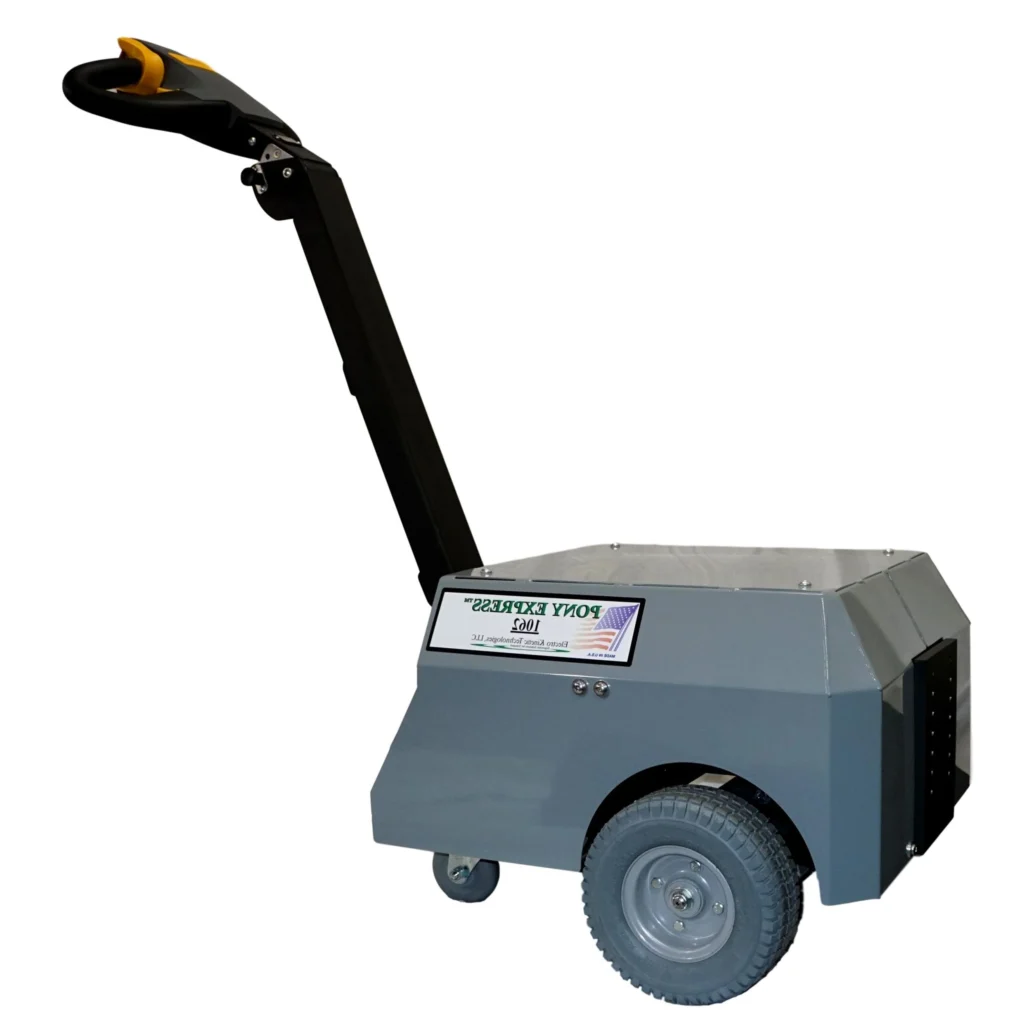
Pick a walk-behind electric tugger when trips run under about 200 yards in standard aisles on a single shift, and only step up to a ride-on for long campus-scale routes or all-day multi-shift hauling. That single rule settles the choice for most hospitals and warehouses. A walk-behind tugger, also called a walkie or pedestrian tugger, hitches to a cart that already rolls and tows it at a walking pace while the operator walks behind it. A ride-on carries a standing or seated operator on a powered platform so they cover ground without walking.
The choice comes down to four plain axes, trip distance, aisle width, load weight, and shift count. Worth saying up front, Heavy Duty Mobility sells walk-behind tuggers only, the USA-built EK Tech Pony Express line, and we cover ride-on here purely as a comparison so you can rule it in or out without a sales pitch pulling the answer one way. Walk-behind capacity here spans 2,000 lbs to 7,500 lbs on a flat surface, far past where most buyers assume they have to ride.
Prices on this page are HDM live sale prices on the EK Tech Pony Express range, current as of June 2026. Last updated June 2026. We equip facilities, we do not certify operators or write your safety program. For powered-equipment training and material-handling ergonomics, follow OSHA and your safety officer.
Our picks at a glance
- Top Pick
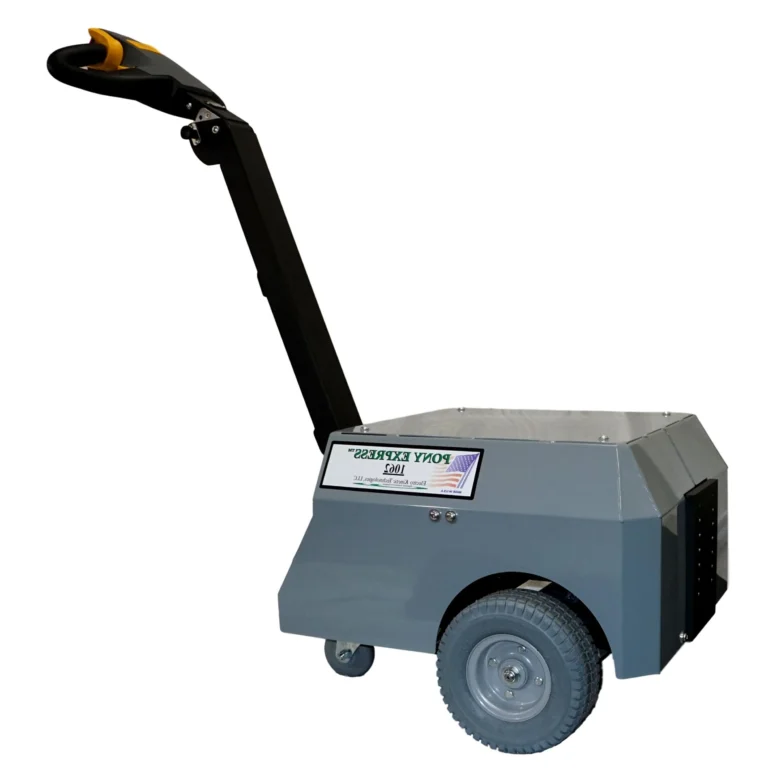 Pony Express 1062 Electric Powered Tugger
- Weight Capacity2000 lbs. on flat surface
- Variable Speed Range0 to 1.5 mph low setting, 0 to 3.0 mph high setting
- Length25"
$5,399View details 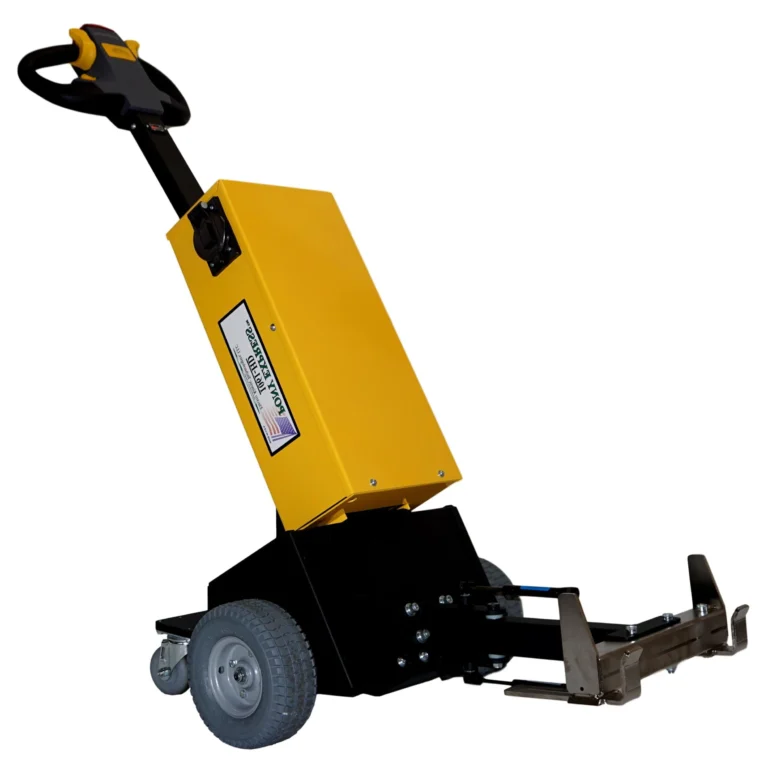 Pony Express 1061-HD Lithium Electric Powered Tugger
- Weight Capacity2000 lbs. on flat surface
- Variable Speed Range0 to 1.5 mph low setting, 0 to 3.0 mph high setting
- Length39" to 54" adjustable
$7,199View details
Walk-behind or ride-on - the short answer
Pick a walk-behind electric tugger when trips run under about 200 yards in standard aisles on a single shift, and step up to a ride-on only for long campus-scale routes or all-day multi-shift hauling. That covers the large majority of facility cart work. If your operator is moving supply carts, linen bins, or rack trains across a building a few dozen times a shift, a pedestrian electric tugger is the right tool and a ride-on is money spent on a problem you do not have.
A ride-on wins on two narrow conditions, and only two. The first is a long continuous route, where an operator would otherwise walk several miles a shift and riding saves their legs without slowing the job. The second is back-to-back shift volume, where the machine has to keep hauling while one shift hands off to the next. Outside those two cases, the smaller and cheaper pedestrian unit does the same work in tighter spaces.
The decision turns on four axes in order, travel distance, aisle width, load weight, and shift throughput. Walk-behind here is not a lightweight category either. The Pony Express line scales from 2,000 lbs to 7,500 lbs on a flat surface in a 24 to 24.5 inch pedestrian frame, and the AC flagship reaches 25,000 lbs on casters, so capacity rarely forces the ride-on question on its own.
What is the difference between a walk-behind and a ride-on tugger?
A walk-behind tugger is a pedestrian unit the operator walks behind on foot, while a ride-on carries a standing or seated operator on a powered platform so they cover ground without walking. That is the whole structural split. The walkie tugger puts the operator on their feet with both hands on an ergonomic handle, a dead-man control that brings the unit to a controlled stop the moment hands leave the controls, and a speed capped to a walking pace by design.
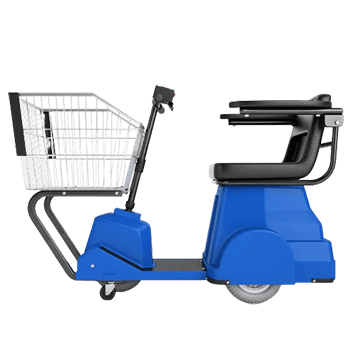
A ride-on tugger, by contrast, gives the operator a platform to stand or sit on. That platform adds length and a turning circle, so the machine carries a larger footprint and is built to cover distance with a rider aboard. HDM does not stock one, and this comparison exists so the difference is clear rather than to sell you the heavier machine.
Footprint is where the two classes separate most on a busy floor. Every walk-behind frame in HDM's lineup is 24 to 24.5 inches wide, and the compact bodies run 25 inches long. The Pony Express 1062 is 25 inches by 24 inches, a body that threads aisles a ride-on platform cannot turn in. A ride-on needs platform length plus room for the operator to swing through a corner.
Speed is the spec that surprises buyers. Every Pony Express walk-behind runs at a controlled 0 to 1.5 mph low setting and 0 to 3.0 mph high setting, a deliberate walking pace the operator keeps up with on foot. A tugger is not a machine you outrun on the floor, so a ride-on buys the operator a rest, not a faster trip. Its real advantage is sparing the legs, not the clock. On terminology, walkie tugger, pedestrian tugger, and walk-behind tugger all name the same pedestrian class, so search results that mix the words still point at one machine.
How far can a walk-behind tugger travel before a ride-on makes sense?
A walk-behind tugger handles round trips up to roughly 200 yards comfortably, and the deciding factor is not battery range but how many miles a day you ask one operator to walk. Push past repeated long hauls across a large campus and the operator's legs, not the machine, become the limit. Under about 200 yards per trip stays squarely in walk-behind territory, and that band covers most dock-to-floor and ward-to-ward moves.
Battery is rarely the constraint, which trips up buyers who assume range forces the ride-on decision. The Pony Express AGM models deliver 8 hours of operation per charge, enough for a full single shift of normal cart moves before the unit ever needs the charger.
The real tradeoff is the operator. A walk-behind makes the person walk every yard the load travels, so on a long enough route the human gives out before the battery does. A ride-on exists to solve exactly that fatigue, not to move loads faster. So the real ceiling on walk-behind distance is set by how far you are willing to ask someone to walk all shift, not by anything on the spec sheet.
Picture two facilities. A warehouse running short repeated dock-to-floor moves, or a hospital shuttling carts ward to ward down corridors, is textbook walk-behind, each trip is short and the operator is never far from the next task. A single long spine corridor run repeated all day, the kind of route that has an operator covering several miles a shift, is where a ride-on starts to earn its keep. Distance is only one axis though. Aisle width is a separate decision, and our guide to pick a tugger for narrow aisles and tight spaces handles that one on its own terms.
- Trip under ~200 yards, single shiftWalk-behindCovers most hospital and warehouse cart moves
- Trip under ~200 yards, multi-shiftWalk-behind lithiumHot-swap 40 Ah pack, ~3 hour recharge for back-to-back shifts
- Long campus route repeated all dayConsider ride-onRiding saves the operator walking several miles a shift
- Long route plus multi-shift volumeRide-on territoryThe one case where a rider clearly earns its cost
How much weight can a walk-behind tugger pull?
Walk-behind tuggers pull far more than most buyers expect, with HDM's Pony Express line moving 2,000 lbs to 7,500 lbs on a flat surface in a pedestrian frame, and the AC model reaching 25,000 lbs on casters. The core walk-behind ladder runs 2,000 lbs, 5,000 lbs, 6,500 lbs, and 7,500 lbs, every rating measured on a flat surface as the spec sheet states. That range alone retires the idea that heavy payloads automatically mean a ride-on.
The myth worth busting is that capacity forces you onto a platform machine. It does not. A 25 inch pedestrian frame already moves a 6,500 lb or 7,500 lb cart train. The Pony Express 1065-HD pulls 6,500 lbs and the 1065-XHD pulls 7,500 lbs, both in the same compact body as the 2,000 lb units, so heavier loads cost you capacity, not footprint.
Two caveats sit behind the weight numbers. The AGM models use an automatic holding brake to stay steady on a graded floor with a reduced pull, so a ramp cuts the safe pulling weight below the flat-floor figure. The lithium model rates its incline by facility rather than a fixed degree, so its safe slope depends on the route. Flat-floor capacity is the rated number, and it is not your worst case the moment the floor tilts.
The ceiling proves the point. The Pony Express AC Tugger 25K+ rates 25,000 lbs on casters and 100,000 lbs on rails, which puts a pedestrian-operated machine squarely into load bands people assume require a ride-on or a forklift. Walk-behind tuggers also come in application-tuned configurations, like the 1065-LS linen and laundry build for hospitals and hotels with its quick-connect bin hitch. If you want the full breakdown by weight, our guide on how to match a tugger to your load weight walks every rung with the rating attached.
Walk-behind electric tugger comparison - 2000 lb to 7500 lb
Here is the full Pony Express walk-behind ladder side by side, from the 2,000 lb 1061-HD entry point to the 7,500 lb 1065-XHD, with the width column doubling as the aisle-fit axis. Read width as the space the machine needs and capacity as the load axis. Every row is a pedestrian unit 24 to 24.5 inches wide, so aisle fit barely changes as capacity climbs, which is the whole reason a heavy load does not have to mean a bigger physical machine.
One row reads differently on purpose. The 1061-HD Lithium trades the AGM 8-hour runtime story for a roughly 3 hour recharge and a hot-swap pack, because its strength is multi-shift uptime rather than capacity. Every price shown is a live sale price, and all six models are in stock. This table stays walk-behind only, since HDM does not sell a ride-on to put in it.
Pony Express walk-behind electric tugger comparison from 2000 lb to 7500 lb. Width is the aisle-fit axis. All values verbatim from manufacturer spec sheets. Prices are live sale prices.
| Model | Weight Capacity | Width | Length | Variable Speed Range | Battery | Range or Recharge | Price |
|---|---|---|---|---|---|---|---|
| Pony Express 1061-HD | 2000 lbs. on flat surface | 24.5" | 39" to 54" adjustable | 0 to 1.5 mph low setting, 0 to 3.0 mph high setting | 35 Ah, AGM Deep Cycle | 8 hours of operation | $4,752 |
| Pony Express 1061-HD Lithium | 2000 lbs. on flat surface | 24.5" | 39" to 54" adjustable | 0 to 1.5 mph low setting, 0 to 3.0 mph high setting | 40 Ah, lithium iron phosphate, hot swappable | Approximately 3 hours recharge | $7,199 |
| Pony Express 1062 | 2000 lbs. on flat surface | 24" | 25" | 0 to 1.5 mph low setting, 0 to 3.0 mph high setting | 35 Ah, AGM, 70 Ah AGM package optional | 8 hours of operation | $5,399 |
| Pony Express 1065 | 5000 lbs. on flat surface | 24" | 25" | 0 to 1.5 mph low setting, 0 to 3.0 mph high setting | 70 Ah, AGM | 8 hours of operation | $6,279 |
| Pony Express 1065-HD | 6500 lbs. on flat surface | 24" | 25" | 0 to 1.5 mph low setting, 0 to 3.0 mph high setting | 70 Ah, AGM | 8 hours of operation | $7,949 |
| Pony Express 1065-XHD | 7500 lbs. on flat surface | 24" | 25" | 0 to 1.5 mph low setting, 0 to 3.0 mph high setting | 70 Ah, AGM | 8 hours of operation | $8,949 |
The default walk-behind pick for most facilities
For most hospitals and warehouses the Pony Express 1062 is the cleanest answer at $5,399, a short 25 inch frame, 2,000 lb flat capacity, and an 8 hour single-shift battery. It lands exactly on the walk-behind sweet spot, under 200 yards per trip, standard aisles, and a single shift, which is why it is the default recommendation when a ride-on would be overkill.
The deciding specs are practical ones. The 25 inch length turns inside standard aisles, the 24 inch width clears tight corridors, and the 2,000 lb flat-surface capacity covers the typical supply cart or linen bin. An optional 70 Ah AGM battery package extends single-charge runtime past the standard 35 Ah pack if your shift runs long.
The walk-behind picks at the heart of this decision
- #1Best overall
Pony Express 1062 Electric Powered Tugger
The cleanest answer to the walk-behind question for most facilities. A short 25 inch frame turns inside standard aisles, the 24 inch width clears tight corridors, and the 2,000 lb flat-surface capacity covers the typical supply cart or linen bin. It runs a 35 Ah AGM pack with an optional 70 Ah AGM upgrade and 8 hours of operation per charge, so it lands exactly on the under-200-yard, standard-aisle, single-shift sweet spot. It also sits in both the compact and hospital-healthcare cart categories, which is why it is the pedestrian-tugger default for care settings.
See price & details- Pros
- 2,000 lbs on a flat surface, covers the typical supply cart or linen bin
- Short 25 inch by 24 inch body turns inside standard aisles
- Optional 70 Ah AGM package extends single-charge runtime
- In stock, built in the USA, mid-priced against the ladder
- Cons
- Fixed 25 inch frame, no adjustable length like the 1061-HD
- AGM pack charges overnight rather than hot-swapping like the lithium model
- #2
Pony Express 1061-HD Lithium Electric Powered Tugger
The walk-behind answer to multi-shift uptime, the one operational gap that usually pushes buyers toward a ride-on. A hot-swappable 40 Ah lithium iron phosphate pack with a roughly 3 hour recharge and Bluetooth battery monitoring lets a pedestrian tugger run back-to-back shifts by swapping a charged pack rather than waiting on a charger. It keeps the same 2,000 lb flat-surface capacity and adjustable 39 to 54 inch frame as the AGM 1061-HD, so the premium buys uptime, not pulling power.
See price & details- Pros
- 2,000 lbs on a flat surface in a 24.5 inch frame
- Hot-swappable 40 Ah lithium pack for back-to-back shifts
- Roughly 3 hour recharge, far quicker than the AGM models
- Bluetooth battery monitoring for fleet status
- Cons
- Longer 39 to 54 inch adjustable frame than the fixed 25 inch 1062 body
- Hot-swap pack is extra hardware to manage versus a sealed AGM unit
The 1062 sits in both the compact and small walk-behind tuggers category and HDM's hospital and healthcare cart category, which reinforces why it is the pedestrian-tugger default for care settings. It is in stock, built in the USA, and mid-priced against the rest of the ladder, so it is neither the cheapest nor the heaviest, just the model that fits the most facilities without compromise.
When does a ride-on tugger actually win?
A ride-on tugger earns its higher cost in exactly two cases, one operator covering long campus-scale routes all day, and multi-shift operations where back-to-back runtime matters more than footprint. For typical facility cart work it wins on little else. If neither of those conditions describes your floor, the walk-behind is not a compromise, it is the correct choice.
The long-route case is the clearest. If an operator would otherwise walk several miles a shift moving carts along a single long corridor or across a sprawling campus, riding the unit saves their legs and keeps throughput steady through the back half of the shift when a walking operator slows down. The job does not move faster, the person just lasts longer.
The multi-shift case is the second, and this is where a walk-behind closes the gap most people assume only a ride-on can. The Pony Express 1061-HD Lithium runs a hot-swappable 40 Ah lithium iron phosphate pack with a roughly 3 hour recharge and Bluetooth battery monitoring, so a pedestrian tugger can run back-to-back shifts by swapping a charged pack rather than waiting on a charger. Uptime, the one operational reason buyers reach for a ride-on, is solvable inside the walk-behind range.
The walk-behind picks at the heart of this decision
- #1Best overall
Pony Express 1062 Electric Powered Tugger
The cleanest answer to the walk-behind question for most facilities. A short 25 inch frame turns inside standard aisles, the 24 inch width clears tight corridors, and the 2,000 lb flat-surface capacity covers the typical supply cart or linen bin. It runs a 35 Ah AGM pack with an optional 70 Ah AGM upgrade and 8 hours of operation per charge, so it lands exactly on the under-200-yard, standard-aisle, single-shift sweet spot. It also sits in both the compact and hospital-healthcare cart categories, which is why it is the pedestrian-tugger default for care settings.
See price & details- Pros
- 2,000 lbs on a flat surface, covers the typical supply cart or linen bin
- Short 25 inch by 24 inch body turns inside standard aisles
- Optional 70 Ah AGM package extends single-charge runtime
- In stock, built in the USA, mid-priced against the ladder
- Cons
- Fixed 25 inch frame, no adjustable length like the 1061-HD
- AGM pack charges overnight rather than hot-swapping like the lithium model
- #2
Pony Express 1061-HD Lithium Electric Powered Tugger
The walk-behind answer to multi-shift uptime, the one operational gap that usually pushes buyers toward a ride-on. A hot-swappable 40 Ah lithium iron phosphate pack with a roughly 3 hour recharge and Bluetooth battery monitoring lets a pedestrian tugger run back-to-back shifts by swapping a charged pack rather than waiting on a charger. It keeps the same 2,000 lb flat-surface capacity and adjustable 39 to 54 inch frame as the AGM 1061-HD, so the premium buys uptime, not pulling power.
See price & details- Pros
- 2,000 lbs on a flat surface in a 24.5 inch frame
- Hot-swappable 40 Ah lithium pack for back-to-back shifts
- Roughly 3 hour recharge, far quicker than the AGM models
- Bluetooth battery monitoring for fleet status
- Cons
- Longer 39 to 54 inch adjustable frame than the fixed 25 inch 1062 body
- Hot-swap pack is extra hardware to manage versus a sealed AGM unit
The ride-on has real downsides for tight facilities too. The platform adds footprint, the machine needs more room to turn, and it is harder to thread through narrow aisles, busy wards, or crowded pick lanes, the exact environments where a 24 inch pedestrian frame shines. To restate the guard plainly, HDM does not sell ride-on tuggers. This section exists so you can rule a ride-on in or out for your own floor, and for most facilities the answer rules it out.
Walk-behind vs ride-on tugger cost - what you actually pay
Walk-behind tuggers run from $4,752 to $8,949 across HDM's 2,000 lb to 7,500 lb ladder, and a ride-on platform sits above that band, so the cost question usually closes in favor of walk-behind unless the route or shift pattern demands a rider. The entry point is the 2,000 lb 1061-HD at $4,752, and the top of the walk-behind range is the 7,500 lb 1065-XHD at $8,949.
Inside the walk-behind ladder, two things drive the price, capacity and battery type. Stepping up the weight tiers from 2,000 lbs to 7,500 lbs walks the price up the ladder, and choosing the lithium pack adds a premium for uptime. The 1061-HD Lithium is $7,199, more than the heavier 5,000 lb AGM 1065 at $6,279, because you are paying for the hot-swap multi-shift capability, not for more pulling power.
Frame the ride-on comparison fairly. A ride-on platform generally costs more than an equivalent-capacity walk-behind, since you are buying the platform, the larger drive system, and the bigger footprint on top of the pulling capacity. So the cheaper, smaller pedestrian unit wins the cost question by default and only flips when the operator-distance or shift math genuinely demands a rider. HDM sells walk-behind only, so this page names no ride-on price, only the direction of the gap.
The total-cost angle is the one most facilities are actually buying. A walk-behind retires manual cart pushing and the back and shoulder strain that comes with it, the kind of repetitive push and pull load OSHA flags as a material-handling injury risk in its ergonomics guidance. That avoided injury cost, not the sticker price, is usually the real return on a pedestrian tugger.
- 1061-HD, 2000 lb AGM$4,752Entry point, retire manual cart pushing
- 1062, 2000 lb AGM$5,399Default single-shift pick
- 1065, 5000 lb AGM$6,279Heavy cart trains, single shift
- 1061-HD Lithium, 2000 lb$7,199Multi-shift uptime premium
- 1065-HD, 6500 lb AGM$7,949Heavy-duty pedestrian
- 1065-XHD, 7500 lb AGM$8,949Top of the walk-behind ladder
How to choose - a 4-step decision rule
Walk through four questions in order, trip distance, aisle width, load weight, and shift count, and the answer points to walk-behind for almost every facility, with a ride-on only when distance and shifts both run high. Take them one at a time and the right machine falls out at the bottom.
- Step 1, distance. Trips under roughly 200 yards stay walk-behind. Repeated long campus runs that have one operator walking several miles a shift are the first signal to consider a ride-on.
- Step 2, aisle. Standard or narrow aisles favor the 24 to 24.5 inch pedestrian frame every time, since a ride-on platform needs more room to turn. If space is tight, the walk-behind is the only one of the two that fits.
- Step 3, load. Match the capacity tier to your heaviest fully loaded cart train, from 2,000 lbs up to 7,500 lbs on the walk-behind ladder, and weigh the cart loaded rather than guessing.
- Step 4, shifts. A single shift takes an AGM model. Multi-shift takes the hot-swap lithium walk-behind. Only a long route plus multi-shift volume together justifies looking at a ride-on at all.
Raphael's rule of thumb When a facility manager is convinced they need a ride-on, I ask them to time one round trip on the longest route, then count how many of those trips happen back to back without a break. If the trip is under two minutes of walking and there is a natural pause between runs, it is a walk-behind job every time, and the lithium hot-swap pack covers the multi-shift worry far cheaper than a rider. The only buyers I send toward a ride-on are the ones whose operators are genuinely walking miles a shift on a single long route with no gaps. That is rarer than people think.
Close by matching the answer to a collection. For light single-shift work, start with the compact and small walk-behind tuggers. For loads above 5,000 lbs, go to the heavy-duty walk-behind tuggers for loads above 5000 lb. To compare the whole lineup at once, browse the full walk-behind electric tugger lineup. And if your decision really hinges on whether a tugger or a heavier machine fits the job, our guide on when a walk-behind tugger beats a forklift carries the next comparison.
Frequently asked questions
Is a walk-behind or ride-on electric tugger better for a warehouse?
For most warehouses a walk-behind tugger is the better fit. If trips run under roughly 200 yards in standard aisles on a single shift, the pedestrian unit moves the same wheeled loads in a tighter footprint for less money. The Pony Express walk-behind line pulls 2,000 lbs to 7,500 lbs on a flat surface in a 24 to 24.5 inch frame, so capacity rarely forces a ride-on. A ride-on earns its cost only when one operator covers long campus-scale routes all day or runs back-to-back multi-shift volume, where the operator walking several miles a shift is the real problem.
How far can a walk-behind tugger travel on one charge?
The Pony Express AGM walk-behind models deliver 8 hours of operation per charge, enough for a full single shift of normal cart moves. The practical distance ceiling is set by how far you are willing to ask one operator to walk, not by the battery, because a walk-behind makes the person walk every yard the load travels. Trips under about 200 yards stay comfortably in walk-behind territory. The 1061-HD Lithium swaps that 8-hour runtime story for a hot-swappable 40 Ah pack with a roughly 3 hour recharge, so it can run back-to-back shifts by swapping a charged pack rather than waiting on a charger.
How much weight can a walk-behind electric tugger pull?
HDM's Pony Express walk-behind line pulls 2,000 lbs to 7,500 lbs on a flat surface, far more than most buyers expect from a pedestrian frame. The ladder runs the 2,000 lb 1061-HD and 1062, the 5,000 lb 1065, the 6,500 lb 1065-HD, and the 7,500 lb 1065-XHD, all in the same compact body. The AC Tugger 25K+ reaches 25,000 lbs on casters and 100,000 lbs on rails, which puts a pedestrian-operated machine into load bands people assume require a ride-on or forklift. All ratings are on a flat surface, and the AGM models use an automatic holding brake to stay steady on a graded floor with a reduced pull, so weigh your cart fully loaded before picking a tier.
Does a walk-behind tugger cost less than a ride-on tugger?
Usually yes. HDM's walk-behind ladder runs from $4,752 for the 2,000 lb 1061-HD to $8,949 for the 7,500 lb 1065-XHD, and a ride-on platform generally sits above that band because you are paying for the platform, a larger drive system, and a bigger footprint on top of the pulling capacity. So the cheaper, smaller pedestrian unit wins the cost question by default and only flips when the route distance or shift pattern genuinely demands a rider. HDM sells walk-behind only, so this comparison names no ride-on price, just the direction of the gap.
Can a pedestrian tugger run more than one shift?
Yes. The Pony Express 1061-HD Lithium runs a hot-swappable 40 Ah lithium iron phosphate pack with a roughly 3 hour recharge and Bluetooth battery monitoring, so a pedestrian tugger can run back-to-back shifts by swapping a charged pack instead of waiting on a charger. That closes the one operational gap, multi-shift uptime, that usually pushes buyers toward a ride-on. The standard AGM models deliver 8 hours of operation per charge, which covers a single shift, so the lithium hot-swap path is the upgrade you pay for only when you actually run multiple shifts.
When is a ride-on tugger worth it over a walk-behind?
A ride-on is worth it in exactly two cases. The first is a long continuous route, where an operator would otherwise walk several miles a shift and riding saves their legs while keeping throughput steady. The second is back-to-back multi-shift hauling where the machine has to keep running across shift changes, though the 1061-HD Lithium hot-swap pack handles much of that inside the walk-behind range. For typical facility cart work under about 200 yards per trip in standard aisles, a ride-on adds footprint and turning needs without moving loads any faster, so the walk-behind is the better tool. HDM does not sell ride-on tuggers, so this guidance is comparative only.