

 4.7
4.7
How to Choose an Electric Tugger for Narrow Aisles and Tight Spaces
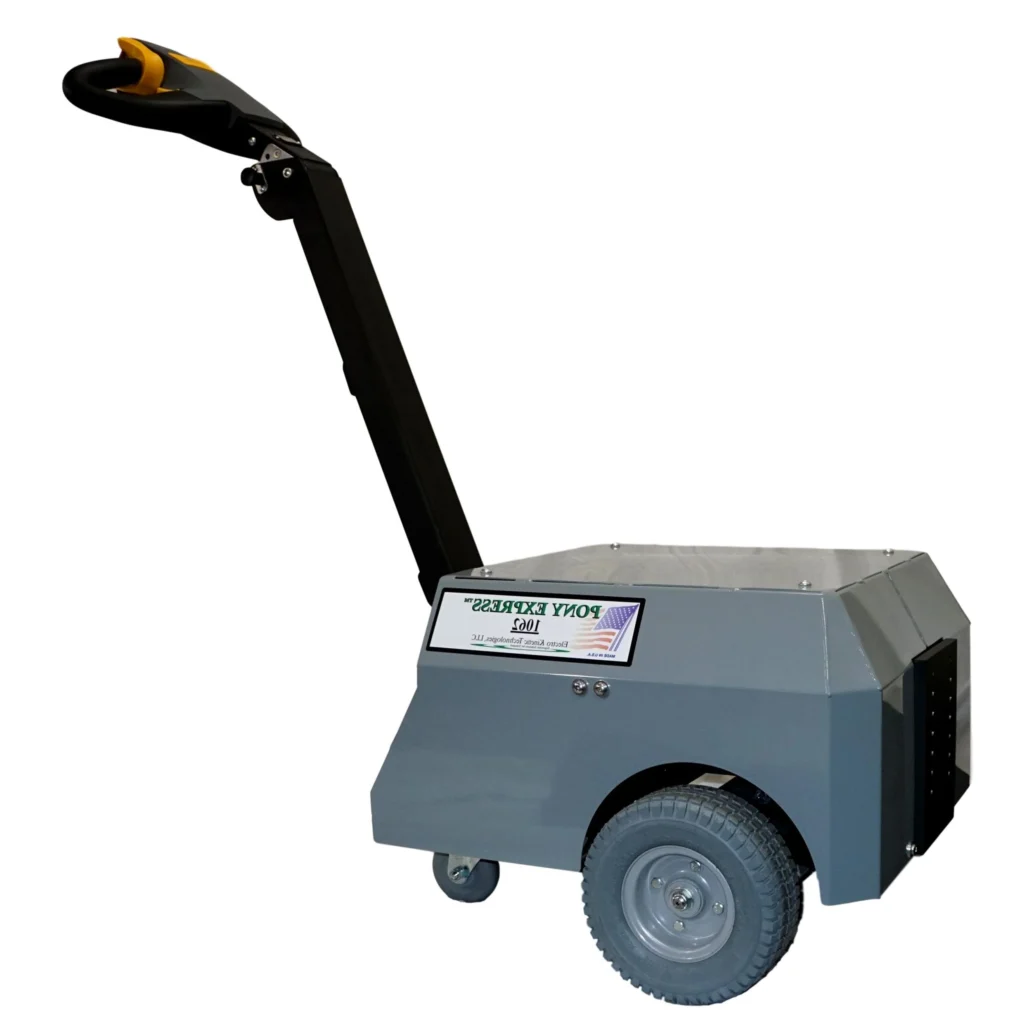
To choose an electric tugger for narrow aisles, measure your three tightest pinch points first, then match the tugger body and drive layout to the gap. The unit has to clear the aisle and still swing the loaded cart behind it, so footprint and pulling power are the two levers that decide everything. We sell three in-stock compact picks that fit this exact problem, the Pony Express 1062, the 1061-HD, and the 1061-HD Lithium, and all three pull 2000 lbs on a flat surface. EK Tech does not publish a numeric turning radius for these tuggers, so we judge maneuverability by body length, width, and center wheel drive rather than inventing a number.
The job runs from a tape measure to a single model, and every spec comes straight off the verified Pony Express product sheets.
Last updated June 2026.
Our picks at a glance
- Top Pick
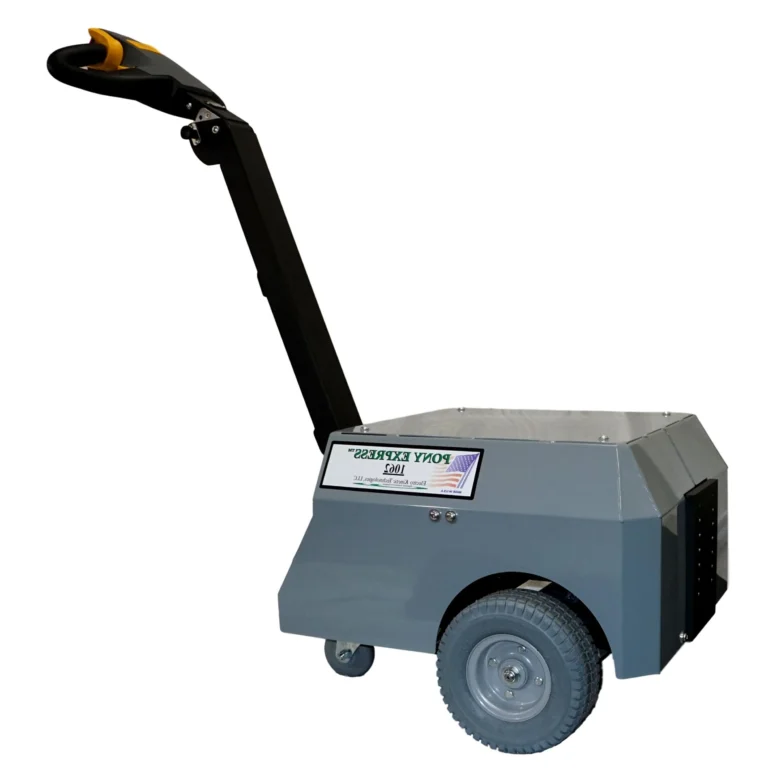 Pony Express 1062 Electric Powered Tugger
- Weight Capacity2000 lbs. on flat surface
- Length25"
- Width24"
$5,399View details 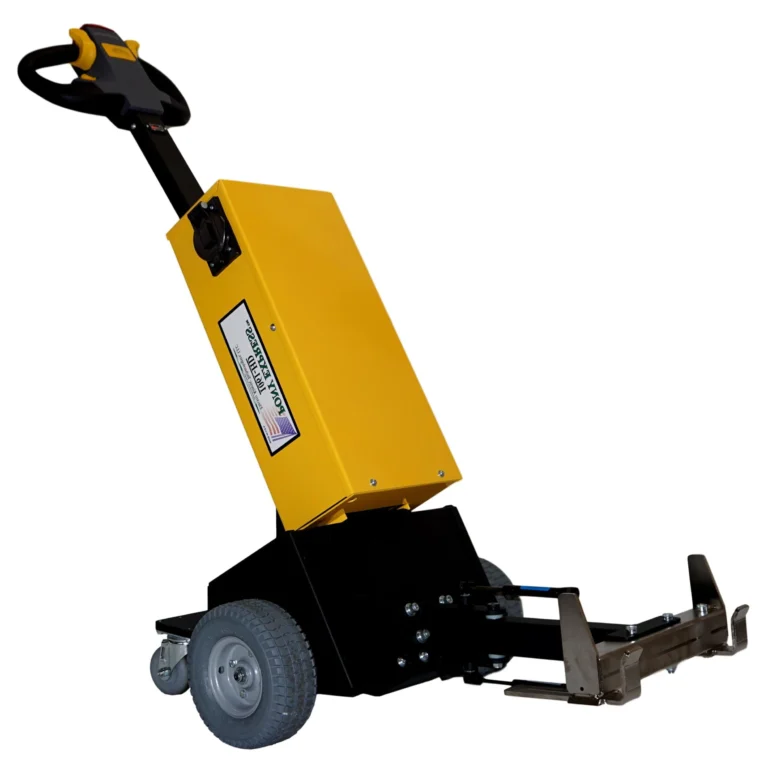 Pony Express 1061-HD Electric Powered Tugger
- Weight Capacity2000 lbs. on flat surface
- Length39" to 54" adjustable
- Width24.5"
$4,752View details- Pony Express 1061-HD Lithium Electric Powered Tugger
- Weight Capacity2000 lbs. on flat surface
- Length39" to 54" adjustable
- Width24.5"
$7,199View details 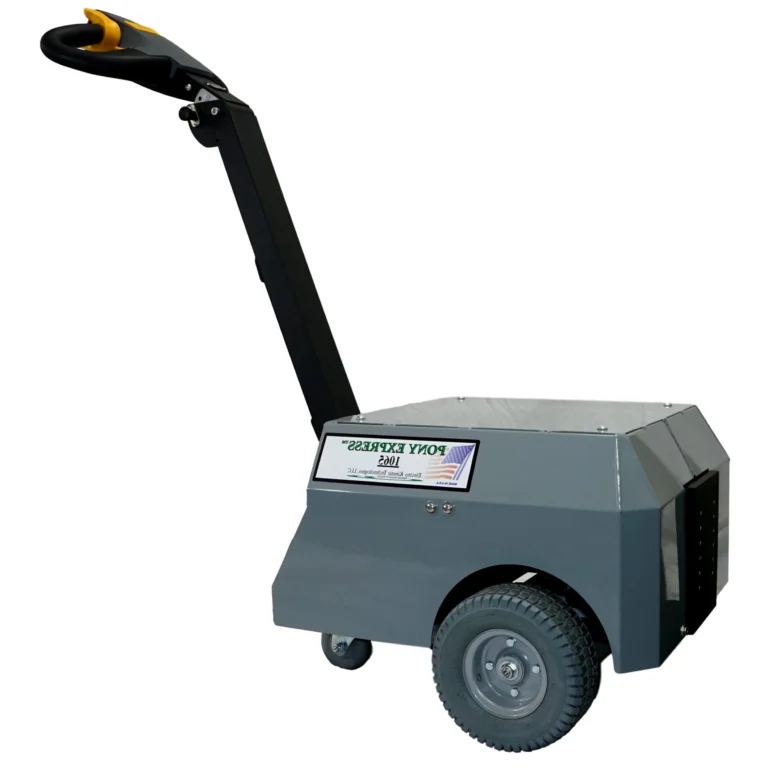 Pony Express 1065 Electric Powered Tugger for Loads up to 5000 lbs$6,279View details
How do you choose an electric tugger for narrow aisles?
You choose an electric tugger for narrow aisles by measuring your tightest aisle width, smallest doorway opening, and shortest elevator depth first, then matching the smallest tugger body that clears all three. The machine has to fit the gap and still rotate the towed load once it gets there, so the body footprint matters more than the motor. A tugger for narrow warehouse aisles lives or dies on its length and width, not its horsepower.
Two levers drive the rest of the decision. The first is footprint, the length and width of the drive unit, because that sets whether it fits your aisle and how tightly it turns. The second is pulling power, the weight capacity on a flat surface, because a machine that fits but cannot move your cart is useless. The three compact Pony Express picks all share the same 2000 lb flat pull, so for most narrow-aisle buyers the decision comes down to footprint and battery, not power.
EK Tech publishes length and width for every Pony Express tugger but not a numeric turning radius, so footprint plus center wheel drive becomes the maneuverability axis. A central pivot tightens the turning circle, which is what matters when no turning-radius figure exists on the spec sheet. It is the same way we would size a unit for you over the phone.
Measure your space before you measure the tugger
Start with three numbers from your own facility, the narrowest aisle width, the smallest doorway clear opening, and the shortest elevator or lift depth, because those gaps cap the maximum tugger footprint you can run. Pull a tape measure before you read a single spec sheet. The building decides the machine, not the other way around.
Measure aisle width at the tightest point, not the average. A run that opens to 60 inches but pinches to 30 inches at one rack upright is a 30 inch aisle for buying purposes, because that pinch point is where a tugger and cart get stuck. Then add operator walk-beside clearance to the bare unit width, since someone walks next to the tugger with a hand on the handle. The 1062 body is 24 inches wide and the two 1061-HD models are 24.5 inches wide, but the real aisle requirement is that width plus room for the operator and the cart behind.
Doorway clear opening matters more than the nominal frame size. Measure the actual gap between the stops with the door fully open, not the rough opening in the drawings, because a 32 inch frame can give you less than 30 inches of real clearance once the slab and stops are in the way. The 24 to 24.5 inch tugger widths leave margin in most commercial doorways, but only if you measure the true opening.
Elevator and lift depth caps the combined tugger plus cart length, since both ride together. This is where the 1062 earns its keep at 25 inches long, while the 1061-HD adjusts from 39 to 54 inches. Measure the shortest car you need to use, subtract your cart length, and that is the longest tugger body you can run through it.
- Step 1 - Narrowest aisle widthMeasure the tightest point inchesAdd operator walk-beside clearance to the 24 to 24.5 inch tugger width
- Step 2 - Doorway clear openingMeasure the actual gap inches1062 body is 24 inch wide, 1061-HD and 1061-HD Lithium are 24.5 inch wide
- Step 3 - Elevator or lift depthMeasure tugger plus cart length inches1062 is 25 inch long, 1061-HD adjusts 39 to 54 inch
Raphael's rule of thumb When I size a tugger for a tight facility, I tell the buyer to take the narrowest aisle measurement and subtract the tugger width, then ask if a person can still walk that gap with a hand on the handle. If the leftover is under about 12 inches on each side, the operator ends up sidestepping and dragging, and the loaded cart starts clipping racks. Better to drop to the shorter 25 inch 1062 body and keep that walking room than to save a few hundred dollars on a longer unit that fights the aisle every trip.
Why footprint and drive layout decide maneuverability, not horsepower
A tugger turns tight because of its body length, width, and drive-wheel position, not its motor, so a short center wheel drive unit out-maneuvers a longer unit even when both pull the same 2000 lbs. Horsepower moves the load. Footprint and drive layout decide if you can get that load around a corner in a cramped supply room. Buyers fixate on capacity and forget that the body is what actually has to fit.
Center wheel drive is the reason the compact Pony Express tuggers pivot tightly. The driven wheel sits at the center of the unit, so the tugger rotates around a point near its own middle instead of swinging a long tail the way a unit driven from one end does. That central pivot shortens the effective turning circle, which is exactly what you want when you are repositioning a cart in a doorway or backing out of a dead-end aisle. The 1062 and the standard 1061-HD both use center wheel drive with foam-filled tires.
Body length is the next factor. A shorter unit reverses and repositions in cramped spaces more easily because there is simply less machine to swing. The 1062 at 25 inches turns and backs in spots where the 39 to 54 inch adjustable 1061-HD body needs more room to come around. If your tightest constraint is a short elevator or a packed storeroom, length is the spec to watch.
Width sets two things at once, whether the unit fits the aisle and how much room the operator has beside it. The 24 inch 1062 and the 24.5 inch 1061-HD bodies are close, but in a truly pinched aisle that half inch plus operator clearance is the difference between a clean pass and a scrape. This is the maneuverability axis the spec sheet actually gives you, which is why footprint matters more here instead of a turning-radius number EK Tech does not publish.
The drive wheels themselves are puncture-proof and non-marking, so they hold traction on smooth indoor floors without leaving black scuff marks on a hospital or showroom surface. A compact electric tugger that scuffs every floor it touches just trades one problem for another.
Compact electric tugger comparison for tight spaces
The three compact Pony Express tuggers share a 2000 lb flat-surface pull, so the choice comes down to footprint, body style, and battery, laid out side by side below. The 1062 wins the footprint row at 25 inches long and 24 inches wide. The 1061-HD adds an adjustable 39 to 54 inch body in a 24.5 inch width and is the lowest-price pick. The 1061-HD Lithium matches that 24.5 inch width but swaps in a hot-swappable lithium pack. The 1065 row is the step-up comparator, same 25 by 24 inch body but a 5000 lb pull for loads that outgrow the compact class.
Compact electric tugger comparison for narrow aisles - footprint, pull, and battery
| Model | Weight Capacity | Length | Width | Variable Speed Range | Battery | Price |
|---|---|---|---|---|---|---|
| Pony Express 1062 | 2000 lbs. on flat surface | 25" | 24" | 0 to 1.5 mph low setting, 0 to 3.0 mph high setting | 35 Ah, AGM, 70 Ah, AGM battery package available as an option | $5,399 |
| Pony Express 1061-HD | 2000 lbs. on flat surface | 39" to 54" adjustable | 24.5" | 0 to 1.5 mph low setting, 0 to 3.0 mph high setting | 35 Ah, AGM Deep Cycle | $4,752 |
| Pony Express 1061-HD Lithium | 2000 lbs. on flat surface | 39" to 54" adjustable | 24.5" | 0 to 1.5 mph low setting, 0 to 3.0 mph high setting | 40 Ah, lithium iron phosphate, hot swappable | $7,199 |
| Pony Express 1065 (step-up) | 5000 lbs. on flat surface | 25" | 24" | 0 to 1.5 mph low setting, 0 to 3.0 mph high setting | 70 Ah, AGM | $6,279 |
Read the table by your tightest constraint. A short elevator or packed storeroom points to the 25 inch 1062 length. Several cart styles point to the adjustable 1061-HD body. Back-to-back shifts point to the lithium recharge. Capacity is a tie across the three compact models, so it does not break the decision unless your load climbs past 2000 lbs.
Pony Express 1062 - the smallest footprint for the tightest aisles
The 1062 is our narrow-aisle top pick because at 25 inches long and 24 inches wide it is the shortest, narrowest body in the compact range, and its center wheel drive gives the tightest turning circle while still pulling 2000 lbs on a flat surface. If your single hardest constraint is fitting through doorways and turning in cramped supply rooms, this is the small electric tugger to start with.
The specs back the pick. It carries 2000 lbs on a flat surface, and an automatic holding brake keeps the load steady on a graded floor with a reduced pull on a slope, so a tight facility does not trade away pulling power to get the small body. The variable speed range runs 0 to 1.5 mph on the low setting for threading doorways and 0 to 3.0 mph on the high setting for open floor, both forward and reverse. The standard battery is a 35 Ah AGM, with a 70 Ah AGM battery package available as an option for longer shifts.
The one tradeoff is the capacity ceiling. The 1062 tops out at 2000 lbs, so a heavier parts cart pushes you to the 1065 or above. And its AGM battery recharges in roughly 4 hours, slower than the lithium sibling, which matters if you cannot pause for a charge. It is made in the USA, in stock, and priced at $5,399, below the lithium model.
Pony Express 1061-HD - the lowest-price adjustable-reach compact
The 1061-HD is the budget compact pick at $4,752 and the only one of the three with an adjustable 39 to 54 inch body, which lets one operator match the hitch reach to different cart styles in a still-narrow 24.5 inch width. If your facility tows a mix of long and short carts and price is a deciding factor, this is the compact electric tugger that flexes to the fleet.
It shares the core compact platform. The pull is 2000 lbs on a flat surface, an automatic holding brake keeps the load steady on a graded floor with a reduced pull on a slope, and the variable speed range is the same 0 to 1.5 mph low and 0 to 3.0 mph high. The battery is a 35 Ah AGM Deep Cycle rated for roughly 8 hours of operation per charge, recharging in about 4 hours. The adjustable length is the real differentiator, since one unit can reach a long flatbed cart and then collapse down for a short bin.
Here is where the adjustable body costs you. That 39 to 54 inch length, even at its shortest setting, is longer than the 25 inch 1062, so it is less nimble in the very tightest aisles and short elevators. The adjustability buys cart flexibility, not extra tight-space agility. If your aisles are the hard limit, the 1062 turns better. If your carts vary and your aisles have a little room, the 1061-HD is the smarter and cheaper buy. It is in stock and made in the USA. For sizing by load rather than aisle, see how to choose an electric tugger by load capacity.
Pony Express 1061-HD Lithium - the multi-shift tight-space pick
The 1061-HD Lithium keeps the narrow 24.5 inch width and 2000 lb pull of the standard 1061-HD but swaps in a hot-swappable 40 Ah lithium iron phosphate pack with a roughly 3 hour recharge, so it runs across back-to-back shifts in a busy tight-space operation. If your bottleneck is charging downtime rather than aisle width, this is the compact pick that keeps moving.
It carries the same body and the same job. The length is the adjustable 39 to 54 inches, the width is 24.5 inches, and the flat-surface pull is 2000 lbs, identical to the standard 1061-HD. The difference lives in the battery. The lithium pack is hot swappable, so an operator drops a depleted pack and clicks in a charged one instead of parking the unit on a charger, and the pack itself recharges in about 3 hours versus the AGM's 4. A Bluetooth app reports battery status to a phone, which helps a supervisor manage a small fleet of units across shifts.
The tradeoff is price. At $7,199 it is the most expensive of the three compact picks, a clear step above the standard 1061-HD. The recharge speed and the swap only pay back if your operation actually runs into charging downtime, a second or third shift, or a route that cannot stop. A single-shift facility rarely needs it and is better served by the cheaper AGM 1061-HD or the smaller 1062. It is in stock and made in the USA.
Compact Pony Express electric tuggers for narrow aisles
- #1Best overall
Pony Express 1062 Electric Powered Tugger
Our narrow-aisle top pick. At 25 inches long and 24 inches wide it is the smallest body in the compact range, and its center wheel drive gives the tightest turning circle for doorways, elevators, and cramped supply rooms. It still pulls 2000 lbs on a flat surface, so a tight facility does not trade away pulling power to get the small body.
See price & details- Pros
- Smallest footprint in the range at 25 inch length, 24 inch width
- Center wheel drive for the tightest turning circle
- 2000 lbs on a flat surface, automatic holding brake for a steady load on a graded floor
- 35 Ah AGM standard with an optional 70 Ah AGM package, made in the USA, in stock
- Cons
- 2000 lb ceiling means heavier carts need the 1065 or above
- AGM recharge is about 4 hours, slower than the lithium sibling
- #2
Pony Express 1061-HD Electric Powered Tugger
The lowest-price compact pick and the only one with an adjustable 39 to 54 inch body, so one operator can match the hitch reach to different cart styles in a still-narrow 24.5 inch width. Same 2000 lb flat pull as the 1062, with the flexibility to tow long and short carts on one unit.
See price & details- Pros
- Adjustable 39 to 54 inch body in a still-narrow 24.5 inch width reaches different cart styles
- Lowest-price compact at $4,752
- 2000 lbs on a flat surface, same dual 0 to 1.5 and 0 to 3.0 mph speeds
- 35 Ah AGM Deep Cycle, roughly 8 hours of operation per charge, in stock
- Cons
- Longer adjustable body is less nimble than the 25 inch 1062 in the tightest aisles
- 35 Ah AGM only, no optional 70 Ah package like the 1062
- #3
Pony Express 1061-HD Lithium Electric Powered Tugger
The multi-shift compact pick. Same narrow 24.5 inch width and 2000 lb pull as the standard 1061-HD, but a hot-swappable 40 Ah lithium iron phosphate pack and a roughly 3 hour recharge keep it running across back-to-back shifts in a busy tight-space operation.
See price & details- Pros
- Same narrow 24.5 inch width and 2000 lb pull as the standard 1061-HD
- Hot-swappable lithium pack, roughly 3 hour recharge for multi-shift uptime
- Bluetooth app reports battery status to a phone for fleet management
- In stock, made in the USA
- Cons
- No optional AGM battery package, lithium pack only
- Recharge speed only pays back when charging downtime is your bottleneck
- #4
Pony Express 1065 Electric Powered Tugger for Loads up to 5000 lbs
The step-up pick for loads heavier than 2000 lbs. It keeps the same compact 25 inch length and 24 inch width as the 1062 but jumps to a 5000 lb flat-surface pull on a larger 70 Ah AGM battery, so you gain capacity without changing the aisle-fit decision.
See price & details- Pros
- Same compact 25 by 24 inch footprint as the 1062, now pulling 5000 lbs
- 70 Ah AGM battery, roughly 8 hours of operation per charge
- Same dual 0 to 1.5 and 0 to 3.0 mph speeds as the compact class
- Automatic holding brake for a steady load on a graded floor, in stock
- Cons
- Heavier unit than the 2000 lb compact models
- Single-battery AGM machine, no lithium option in this exact SKU
What if your loads outgrow the 2000 lb compact class?
If your carts run heavier than 2000 lbs you do not have to give up the tight footprint, because the Pony Express 1065 keeps the same 25 inch length and 24 inch width as the 1062 but jumps to a 5000 lb flat-surface pull. The aisle-fit decision does not change when you step up capacity, since the body stays the same size. You buy more pulling power without buying a bigger machine.
The ladder goes higher in that same body. The 1065-HD reaches 6500 lbs on a flat surface in the identical 25 by 24 inch footprint, the top of the same-footprint heavy-duty range. Both the 1065 and the 1065-HD use a larger 70 Ah AGM battery rather than the compact models' 35 Ah pack, which is where the extra capacity comes from. The footprint holds constant, the battery and motor scale up, and the unit weighs more, but it still threads the same aisles and doorways the 1062 does.
That is the key point for a narrow-aisle buyer. Capacity climbs by battery and motor, not by body size, so the measure-first rule carries straight over to the heavier tiers. Measure your aisles once and the same 25 by 24 inch footprint answer holds all the way from 2000 lbs of pull up to 6500 lbs. When your loads cross the compact ceiling, step up to heavy-duty electric tuggers when loads outgrow the compact class.
How to read aisle width, doorways, and elevators into a final pick
Turn your three facility measurements into one tugger choice by matching the smallest gap to the smallest body that clears it, then stepping up capacity only if your load demands it. Start from the tightest constraint and work outward.
- Tightest aisles and shortest elevator point to the 1062. The 25 inch length and 24 inch width are the smallest footprint in the range, and center wheel drive gives the tightest turning circle. This is the pick when the building is the hard limit.
- Mixed cart styles and a tighter budget point to the 1061-HD. The adjustable 39 to 54 inch body reaches long and short carts, and at $4,752 it is the lowest-price compact, as long as your aisles have a little room beyond the bare 24.5 inch width.
- Back-to-back shifts point to the 1061-HD Lithium. Same narrow body, but the hot-swap lithium pack and roughly 3 hour recharge keep it running when charging downtime is your bottleneck.
- Loads heavier than 2000 lbs point to the 1065. Same 25 by 24 inch body, 5000 lb pull, so you keep the aisle fit and gain the capacity.
All four are in stock and made in the USA. When you are ready to compare prices and stock, shop compact and small electric tuggers built for tight spaces or browse the full electric tugger range. If you are new to the category and want the basics first, start with what an electric tugger is and how it works.
Frequently asked questions
What is the smallest electric tugger for narrow aisles?
The Pony Express 1062 is the smallest electric tugger in the Pony Express compact range at 25 inches long and 24 inches wide. That short, narrow body plus its center wheel drive give it the tightest turning circle for narrow aisles, doorways, and elevators, and it still pulls 2000 lbs on a flat surface. The two 1061-HD models are slightly wider at 24.5 inches and use an adjustable 39 to 54 inch length, so the 1062 is the pick when fitting through the tightest gaps is your hard constraint. It is in stock and priced at $5,399.
How tight can an electric tugger turn in a narrow aisle?
EK Tech does not publish a numeric turning radius for the Pony Express tuggers, so we judge it by footprint and drive layout instead. The compact 1062 and the standard 1061-HD use center wheel drive, where the driven wheel sits near the middle of the unit, so the tugger rotates around a central point rather than swinging a long tail. A shorter body turns tighter, which is why the 25 inch 1062 repositions in cramped supply rooms more easily than the longer 39 to 54 inch 1061-HD. Use length and width as the maneuverability comparison, not a turning-radius number.
How wide an aisle do you need for a compact electric tugger?
Start from the bare tugger width and add operator walk-beside clearance, because someone walks next to the unit with a hand on the handle. The 1062 body is 24 inches wide and the 1061-HD and 1061-HD Lithium are 24.5 inches wide, so the real aisle requirement is that width plus room for the operator and the towed cart to track behind. Measure your aisle at its tightest pinch point, not the average, since that is where a tugger and cart actually get stuck. For most commercial aisles the 24 to 24.5 inch bodies leave usable margin, but only if you measure the true clearance.
Can a small electric tugger still pull heavy carts?
Yes. All three compact Pony Express tuggers pull 2000 lbs on a flat surface despite their small footprint, and the 1062 and standard 1061-HD also use an automatic holding brake that keeps the load steady on a graded floor with a reduced pull on a slope. If your carts run heavier than 2000 lbs you keep the tight footprint by stepping up to the 1065, which holds the same 25 inch length and 24 inch width but jumps to a 5000 lb flat-surface pull on a larger 70 Ah AGM battery. The 1065-HD reaches 6500 lbs in that same body. Capacity climbs by battery and motor, not by body size.
Which compact electric tugger is best for back-to-back shifts?
The Pony Express 1061-HD Lithium is the pick for back-to-back shifts. It keeps the narrow 24.5 inch width and 2000 lb pull of the standard 1061-HD but uses a hot-swappable 40 Ah lithium iron phosphate pack that recharges in roughly 3 hours, versus about 4 hours for the AGM models. An operator can drop a depleted pack and click in a charged one instead of parking the unit on a charger, and a Bluetooth app reports battery status to a phone. At $7,199 it costs more than the AGM 1061-HD, so it only pays back when charging downtime is your real bottleneck.
Sources & references
- EK Tech Pony Express 1062 Electric Powered Tugger - manufacturer spec sheet Authority
- EK Tech Pony Express 1061-HD Electric Powered Tugger - manufacturer spec sheet Authority
- EK Tech Pony Express 1061-HD Lithium Electric Powered Tugger - manufacturer spec sheet Authority
- EK Tech Pony Express 1065 Electric Powered Tugger - manufacturer spec sheet Authority
- OSHA - Powered Industrial Trucks safety standard 1910.178 Authority