

 4.7
4.7
When to Use a Tugger Instead of a Forklift – A Walk-Behind ROI Comparison
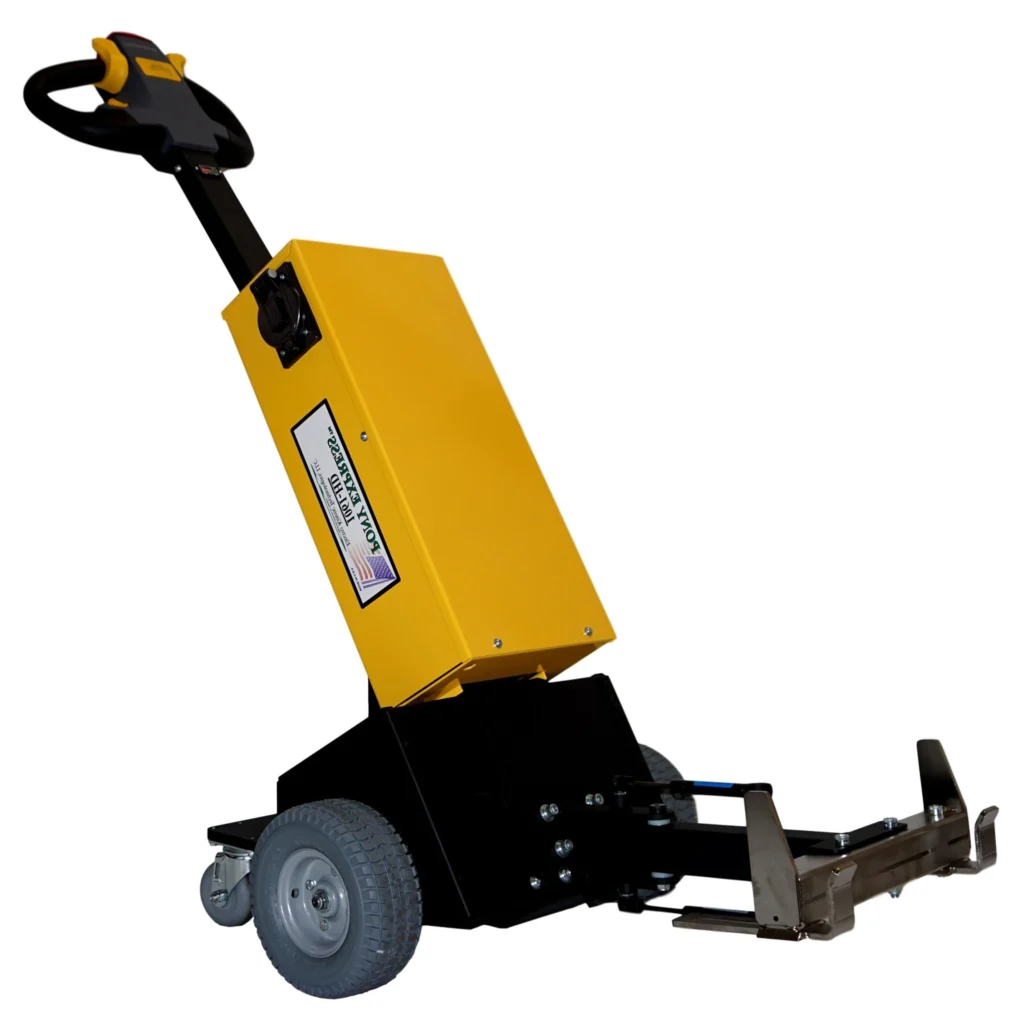
Use a tugger instead of a forklift when the job is horizontal transport, pulling wheeled loads across a flat floor, and keep the forklift for any work that lifts. That one line settles most of the decision. A walk-behind electric tugger hitches to a cart that already rolls and tows it at a walking pace. It does not raise a load, stack a pallet, or reach into a trailer.
Most facility managers weighing this already own a forklift for in-plant moves and want to know where a tugger does that horizontal work for less. Everything here is walk-behind, pedestrian operated, with no ride-on machine and no forklift being recommended. Tuggers move loads on casters or rails, they never lift them off the floor. What is different here is that we publish every price up front. Real walk-behind tugger prices run from $4,752 for a 2,000 lb model up to $20,195 for a 25,000 lb industrial unit, and most forklift-comparison pages hide those exact numbers behind a quote form.
Prices on this page are HDM live sale prices on the EK Tech Pony Express range, current as of June 2026. Last updated June 2026. We equip facilities, we do not certify operators. For forklift training and powered-industrial-truck compliance, follow OSHA and your safety officer.
Our picks at a glance
- Top Pick
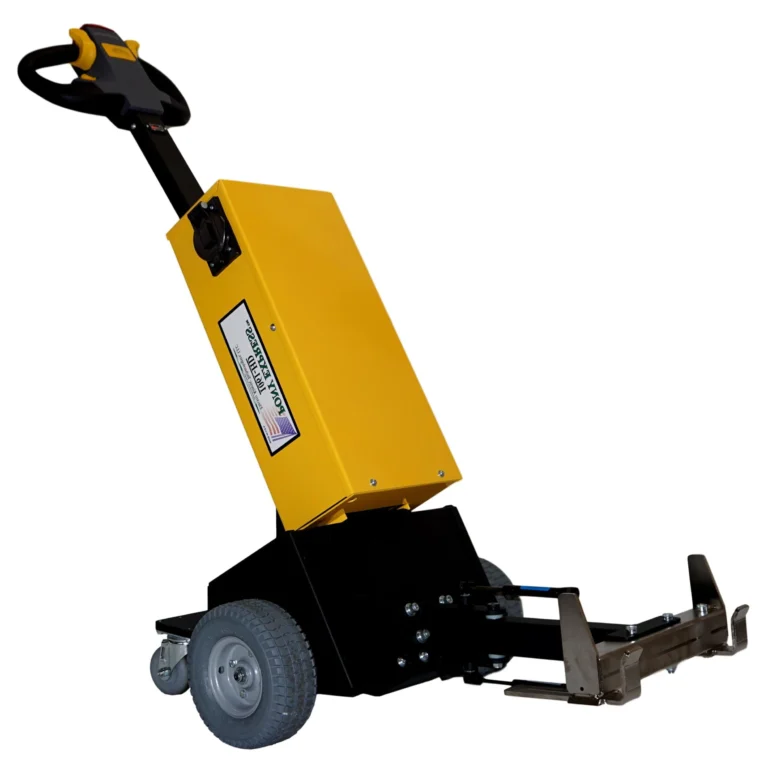 Pony Express 1061-HD Electric Powered Tugger
- Weight Capacity2000 lbs. on flat surface
- Incline RatingHolding brake, de-rated on a slope
- Width24.5"
$4,752View details 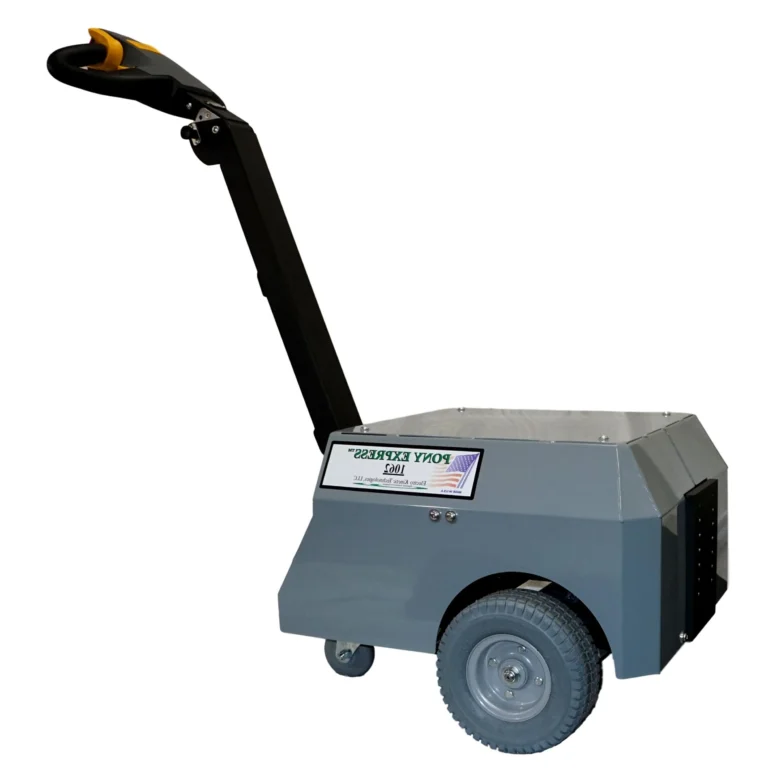 Pony Express 1062 Electric Powered Tugger
- Weight Capacity2000 lbs. on flat surface
- Incline RatingHolding brake, de-rated on a slope
- Length25"
$5,399View details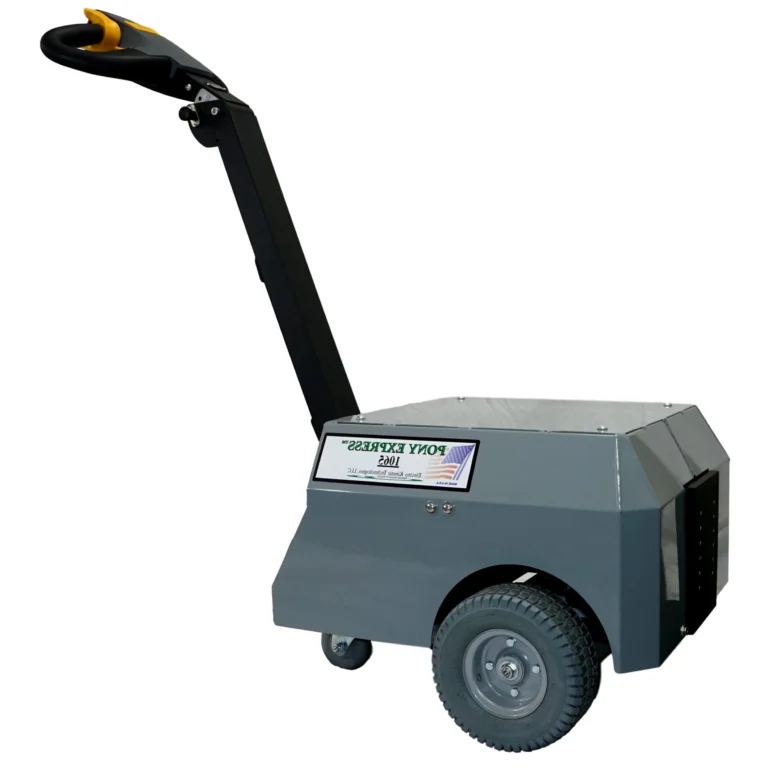 Pony Express 1065 Electric Powered Tugger for Loads up to 5000 lbs
- Weight Capacity5000 lbs. on flat surface
- Incline RatingHolding brake, de-rated on a slope
- Length25"
$6,279View details- Pony Express 1065-HD Electric Powered Tugger for Loads up to 6500 lbs
- Weight Capacity6500 lbs. on flat surface
- Incline RatingHolding brake, de-rated on a slope
- Length25"
$7,949View details 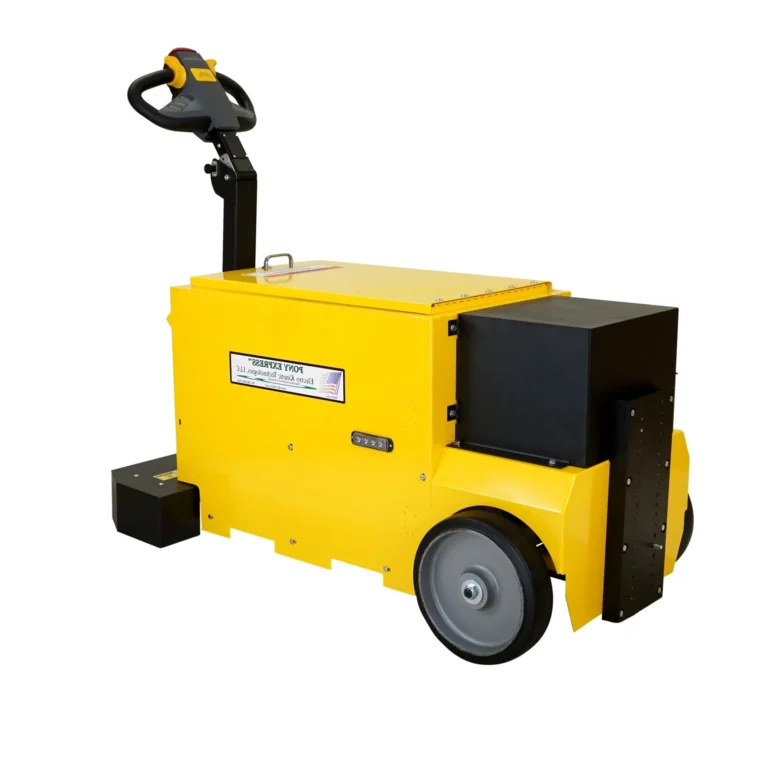 Pony Express Electric Powered AC Tugger 25K+
- Weight Capacity Casters25,000 lbs.
- Weight Capacity Rails100,000 lbs.
- Product Length52"
$20,195View details
When should you use a tugger instead of a forklift?
Use a tugger instead of a forklift when the task is horizontal transport of wheeled loads on a flat floor, and keep the forklift for lifting and stacking. The split is that simple. If the load needs to go up onto a rack or into a trailer, that is forklift work. If it just needs to go across the building on wheels, a tugger does it cheaper and in tighter spaces.
The one-line rule is worth memorizing before you spend anything. A tugger pulls, a forklift lifts. So the only question that matters is whether the load needs to travel up or just across. A pallet that has to land on a rack at height is a lift. A loaded cart, rack, or bin that has to cross the plant is a pull.
Most of the people asking this question already own a forklift and use it for everything, including the horizontal moves it was never built for. That is the expensive habit this page is meant to break. A counterbalance forklift burning propane to tow a cart point to point is wasted capital and wasted fuel for a job a $4,752 walk-behind tugger does for less.
The scope stays narrow on purpose. Nothing below is a ride-on machine and nothing recommends a forklift as the buy, because the whole comparison is the return on investment of horizontal transport, the cost of moving wheeled loads rather than lifting them. If you want the mechanics first, our explainer on how an electric tugger actually works covers the hitch, the drive, and the safety controls before you read prices.
Tugger vs forklift - what each machine is actually for
A forklift lifts and stacks loads vertically, a tugger pulls wheeled loads horizontally, so they solve two different problems and the cheap mistake is buying a forklift to do a tugger's job. The forklift is a vertical-lift machine. A counterbalance mast raises a pallet, sets it on a rack, and pulls it back down, and the counterweight in the chassis keeps the whole thing from tipping forward under load. That mast and counterweight are most of what you pay for, and most of why the machine is so wide.
An electric tugger is a pedestrian-operated drive unit. It hitches to a cart or bin that already sits on casters and tows it across a flat floor at walking pace. There is no mast, no fork, and no lift. The EK Tech Pony Express units here run a high-torque 24V DC motor on the standard range and a 48V AC transaxle on the industrial flagship, with regenerative braking and an automatic holding brake so the load does not run away on a slope.
The overlap is where buyers get confused and where money leaks. A lot of facilities reach for the forklift for horizontal moves it was never designed to do, because it is the powered machine already on the floor. Doing that burns fuel, ties up an expensive lift truck on a towing job, and forces wide aisles the tugger would not need.
That distinction sets the whole return-on-investment math. If a load already rolls on casters, paying for lift capacity you never use is wasted capital up front and wasted operating cost every shift. The decision is not which machine is better in the abstract. It is whether the load needs to leave the floor at all.
Five signs the job calls for a tugger, not a forklift
Reach for a tugger over a forklift when the load rolls, the aisles are tight, the moves repeat all shift, the trip runs long across the plant, or you want to drop fuel and certification overhead. Any one of these points toward a tugger. Two or more, and the forklift is the wrong tool for that particular task.
Sign 1, the load is on wheels or can sit on a cart. If it rolls, it needs pulling, not lifting, and a tugger is built to pull. Forks are wasted on a load that never leaves the floor.
Sign 2, the aisles are too narrow for a counterbalance forklift. A sit-down forklift needs real width to turn with a load on the forks. A walk-behind tugger clears a 24 to 24.5 inch corridor. The Pony Express 1062 is 25 inches long by 24 inches wide, a body that threads aisles no counterbalance truck can enter.
Sign 3, the same horizontal route runs dozens of times a shift. Repetition is where a tugger-and-cart train pays back. One operator can pull a string of carts in a single trip instead of shuttling the forklift back and forth one load at a time.
Sign 4, the trip is long across the plant. A forklift idling between moves on a long route is wasted runtime and wasted fuel. A tugger is sized for exactly this kind of steady horizontal hauling at a walking pace.
Sign 5, you want to cut fuel overhead. A tugger drops propane and diesel and charges on a standard 120 or 240 VAC outlet, so there is no fuel to buy and no fuel storage to manage. Operator training under OSHA 29 CFR 1910.178 still applies to any powered industrial truck, a forklift or a powered tugger alike, so count it on both sides of the math rather than as a tugger saving.
- Does the load need to go up onto a rack or into a trailer?YesKeep the forklift - a tugger does not lift
- Is the load on wheels or can it sit on a cart?YesTugger candidate - it pulls wheeled loads
- Is the aisle narrower than a counterbalance forklift can clear?Under 30 inWalk-behind tugger clears a 24 to 24.5 in corridor
- Does the same horizontal route repeat through the shift?Many tripsTugger and cart train moves more per trip
- Do you want to drop fuel and operator certification overhead?YesElectric tugger charges on a standard 120 or 240 VAC outlet
Is a tugger cheaper than a forklift?
Yes, for horizontal transport a walk-behind tugger costs a fraction of a comparable forklift up front and carries almost none of the recurring fuel and certification cost a forklift does. On a job that is pure horizontal moving, the tugger wins on purchase price and on operating cost both. The catch is that this only holds for moving wheeled loads, which is the whole point of the comparison.
Start with the purchase price. The 5,000 lb Pony Express 1065 is $6,279 and the 6,500 lb 1065-HD is $7,949. A new powered forklift rated to lift those same weights runs well above either number, and that gap exists before you have bought a drop of fuel.
Then the running cost. A tugger charges on a standard 120 or 240 VAC wall outlet. There is no propane tank to swap, no diesel to buy, and no fuel storage to manage. A forklift's fuel line is a permanent recurring bill that a tugger simply does not have.
Compliance sits on both sides of the ledger, so do not bank it as a saving. A powered industrial truck falls under OSHA's powered industrial truck rules, which means trained and evaluated operators, a documented program, and a pre-shift inspection, and OSHA's operator-training requirement reaches powered walk-behind tuggers too, not just ride-on forklifts. Where a tugger genuinely cuts cost is fuel, no propane tank, no diesel, and no fuel storage to manage. Train your operators on either machine and confirm your own requirements with your safety officer.
The caveat is simple and worth stating plainly. This is purchase and running cost for horizontal moves only. A tugger does not do the lifting a forklift does, so it is not an apples-to-apples capacity swap and it does not retire your forklift. If you want the full cost picture by capacity band, our full electric tugger price breakdown by load capacity walks every rung with the dollar figure attached.
Walk-behind electric tugger price and load ladder
HDM publishes every tugger price, from the 2,000 lb Pony Express 1061-HD at $4,752 up to the 25,000 lb AC 25K+ at $20,195, so you can match load rating to budget without a quote form. That published price is unusual, because most forklift-comparison pages in this category end in a callback request. This one gives you the number next to the capacity and lets you do your own math.
Walk the ladder by capacity. The band runs 2,000 lb, 5,000 lb, 6,500 lb, 7,500 lb, and 25,000 lb on casters, with the industrial flagship rated up to 100,000 lbs on rails. Between the 6,500 lb 1065-HD and the AC flagship sits the 7,500 lb Pony Express 1065-XHD at $8,949, the top DC rung and the top of the standard 24V DC range. Name that rung and the band reads continuously from $4,752 all the way to $20,195.
A few specs hold steady across the range. Top speed is 3.0 mph on the high setting on every model, because these are walk-behind units paced to a person, not racing machines. The DC range uses an automatic holding brake to keep the load steady on a graded floor, with a reduced pull on a slope, so a ramp cuts the weight the machine can safely move. The AC 25K+ recharges in roughly 90 minutes on its external charger, against the four hour recharge of the AGM DC units, which matters when a 25,000 lb job cannot sit idle mid-shift.
The table below lines five rungs up against a forklift's lift-only job. Find the row that covers your heaviest loaded cart, read the price next to it, and compare that to what a forklift rated to lift the same weight would cost.
Pony Express walk-behind electric tugger load and price ladder versus a forklift's lift-only job
| Model | Weight Capacity | Footprint (L x W) | Top Speed | Incline Rating | Battery / Runtime | Price |
|---|---|---|---|---|---|---|
| Pony Express 1061-HD | 2000 lbs. on flat surface | 39" to 54" adjustable x 24.5" | 3.0 mph high setting | Holding brake, de-rated pull on a slope | 35 Ah AGM / 8 hours of operation | $4,752 |
| Pony Express 1062 | 2000 lbs. on flat surface | 25" x 24" | 3.0 mph high setting | Holding brake, de-rated pull on a slope | 35 Ah AGM / 8 hours of operation | $5,399 |
| Pony Express 1065 | 5000 lbs. on flat surface | 25" x 24" | 3.0 mph high setting | Holding brake, de-rated pull on a slope | 70 Ah AGM / 8 hours of operation | $6,279 |
| Pony Express 1065-HD | 6500 lbs. on flat surface | 25" x 24" | 3.0 mph high setting | Holding brake, de-rated pull on a slope | 70 Ah AGM / 8 hours of operation | $7,949 |
| Pony Express AC 25K+ | 25,000 lbs. casters / 100,000 lbs. rails | 52" x 30" | 3.0 mph high setting | 48 VDC 100 Ah AGM or 120 Ah lithium iron phosphate / 8 hours of operation | $20,195 |
Raphael's rule of thumb When a buyer is torn between keeping the forklift on a route or moving it to a tugger, I ask one question. Does that load ever leave the floor on that trip? If the answer is no, not even once, it is a tugger run and the forklift is overkill for it. Then I tell them to weigh the cart fully loaded and buy the next capacity band up, because the holding brake steadies the load on a graded floor but the pull de-rates on a ramp, so the flat-floor number is not your worst case if your route has a slope.
The five Pony Express tuggers that replace a forklift run
Each rung on the ladder targets a different horizontal-transport job a facility would otherwise hand to a forklift, from a 2,000 lb cart in a tight aisle to a 25,000 lb load on casters. The cards below are framed by the forklift run each one displaces, not by the spec sheet alone. The 2,000 lb 1061-HD proves the math on the cheapest move. The 1062 wins on space in the tightest aisles. The 1065 is the 5,000 lb crossover that matches many warehouse forklift ratings. The 1065-HD covers loads a plant would buy a 7,000 lb forklift to lift. The AC 25K+ anchors the table against six-figure heavy forklifts.
The Pony Express tuggers that replace a forklift run
- #1Best overall
Pony Express 1061-HD Electric Powered Tugger
The lowest published price in the range and the cheapest way to prove the forklift-replacement math. It pulls 2,000 lbs on a flat surface in a 24.5 inch corridor a sit-down forklift cannot enter, on a 35 Ah AGM deep cycle battery with roughly 8 hours of operation per charge. The adjustable 39 to 54 inch frame stretches to reach longer carts. This is the entry rung for testing whether a tugger fits a horizontal run before scaling up.
See price & details- Pros
- Pulls 2,000 lbs on a flat surface in a 24.5 inch wide body
- Lowest published price in the lineup at $4,752
- Adjustable 39 to 54 inch length reaches longer carts
- In stock with a published price and no quote form
- Cons
- 35 Ah AGM only, recharge is about 4 hours
- 2,000 lb ceiling means heavier carts need the 1065 or above
- #2
Pony Express 1062 Electric Powered Tugger
The same 2,000 lb pull in the most compact body in the range, a 25 inch deck length by 24 inches wide for the tightest aisles. This is the rung that answers when a tugger beats a forklift on space and not just cost, since no counterbalance forklift turns in a 24 inch corridor. It runs a 35 Ah AGM pack with a 70 Ah AGM upgrade available, and roughly 8 hours of operation per charge.
See price & details- Pros
- Pulls 2,000 lbs on a flat surface for the tightest aisles
- Most compact body in the range at 25 inches long by 24 inches wide
- Optional 70 Ah AGM battery package for longer runtime
- Dual 0 to 1.5 and 0 to 3.0 mph walking-pace speeds
- Cons
- Fixed 25 inch frame, no adjustable length like the 1061-HD
- Same 2,000 lb ceiling, so heavier loads need the 1065
- #3
Pony Express 1065 Electric Powered Tugger for Loads up to 5000 lbs
The 5,000 lb crossover where the capacity argument lands. It matches the rated load of many warehouse forklifts at a fraction of the purchase price and with none of the fuel overhead a forklift carries, all on a compact 25 inch by 24 inch body. It runs a 70 Ah AGM pack, roughly 8 hours per charge, and an automatic holding brake that steadies the load on a graded floor with a reduced pull on a slope. The right rung when carts outgrow 2,000 lb but the job is still horizontal.
See price & details- Pros
- 5,000 lbs on a flat surface for $6,279
- Matches many warehouse forklift load ratings
- Compact 25 inch by 24 inch body despite the higher capacity
- Charges on a standard 120 or 240 VAC outlet, no propane
- Cons
- AGM recharge is about 4 hours, no lithium option in this SKU
- For 6,500 lb and up you step to the 1065-HD
- #4
Pony Express 1065-HD Electric Powered Tugger for Loads up to 6500 lbs
The 6,500 lb walk-behind that covers loads a facility would otherwise buy a 7,000 lb forklift to lift, while still walking through standard doorways. It keeps the same 25 inch by 24 inch chassis and 70 Ah AGM pack as the mid 1065, so the step from $6,279 to $7,949 is paying for pulling capacity, not a bigger machine. The right rung for carts in the high 5,000s to low 6,000s.
See price & details- Pros
- 6,500 lbs on a flat surface for $7,949
- Same compact 25 inch by 24 inch footprint as the mid 1065
- 70 Ah AGM, roughly 8 hours of operation per charge
- Automatic holding brake steadies the load on a graded floor
- Cons
- AGM recharge is about 4 hours
- For loads past 7,000 lb you want the 1065-XHD at $8,949
- #5
Pony Express Electric Powered AC Tugger 25K+
The published-price ceiling and the only AC machine in the family. Its price is the number that anchors the ROI against six-figure heavy forklifts. A 1.7 kW transaxle on AC Vector Power technology moves 25,000 lbs on casters and 100,000 lbs on rails, on a 52 inch by 30 inch body, with a choice of 48 VDC 100 Ah AGM or 48 VDC 120 Ah lithium iron phosphate batteries, Bluetooth fleet monitoring, and a roughly 90 minute recharge. Built for rail-car work, die moving, and extreme-load material handling.
See price & details- Pros
- 25,000 lbs on casters and 100,000 lbs on rails, the heaviest in the range
- 1.7 kW AC Vector Power transaxle, roughly 90 minute recharge
- Choice of 100 Ah AGM or 120 Ah lithium iron phosphate battery
- Undercuts six-figure heavy forklifts for comparable horizontal moves
- Cons
- Larger 52 inch by 30 inch body than the compact DC range
- Far more capacity than any job under heavy industrial and rail work needs
Pony Express 1061-HD - the 2,000 lb entry point at $4,752
The Pony Express 1061-HD is the lowest-priced rung and the cheapest way to test the forklift-replacement math, pulling 2,000 lbs in a 24.5 inch corridor on an 8-hour AGM charge. It carries 2,000 lbs on a flat surface, runs a 35 Ah AGM deep cycle battery, and uses an adjustable 39 to 54 inch frame that stretches to reach longer carts while staying 24.5 inches wide. Figure roughly 8 hours of operation per charge with about a 4 hour recharge.
The forklift run it replaces is repetitive single-cart moves a sit-down forklift cannot even reach in tight aisles. If your facility is towing a 2,000 lb supply cart or linen bin across the building a dozen times a shift, this is the cleanest place to prove the ROI before you scale up the range.
If downtime rather than capacity is your limit, the lithium sibling is the upgrade path. The 1061-HD Lithium runs $7,199 for the same 2,000 lb rating, and the premium buys a hot-swappable 40 Ah lithium iron phosphate pack with about a 3 hour recharge. On a single shift the AGM saves the money. On back-to-back shifts the hot-swap pack is what you are paying for.
Pony Express 1065 - the 5,000 lb forklift-capacity crossover at $6,279
The Pony Express 1065 moves 5,000 lbs on a flat floor, matching the rated capacity of many warehouse forklifts at a fraction of the purchase price and with no fuel to buy. It runs a 70 Ah AGM pack, roughly 8 hours of operation per charge, and an automatic holding brake that keeps the load steady on a graded floor with a reduced pull on a slope, all on a compact 25 inch by 24 inch footprint.
This is the rung where the capacity argument actually lands. A 5,000 lb horizontal move is the kind of job a mid-size warehouse forklift would normally handle, and the 1065 does it for $6,279 instead of forklift money. The body stays compact, so it threads aisles the forklift cannot, and it tows the same weight without the mast you do not need on a horizontal run.
Tie it back to operating cost. The 1065 charges on a standard outlet, so there is no propane, no diesel, and no fuel storage. The whole running-cost case for moving a forklift's horizontal work onto a tugger shows up most clearly at this rung, where the capacity matches but the overhead does not follow.
Pony Express AC 25K+ - 25,000 lbs on casters at $20,195
The Pony Express AC 25K+ is the published-price ceiling. It is a 48V AC tugger moving 25,000 lbs on casters and up to 100,000 lbs on rails with a roughly 90-minute recharge, and its price is the number that anchors the ROI against six-figure heavy forklifts. It runs a 1.7 kW transaxle on AC Vector Power technology, a 52 inch by 30 inch body, and a choice of 48 VDC 100 Ah AGM or 48 VDC 120 Ah lithium iron phosphate batteries with Bluetooth fleet monitoring.
The forklift it displaces is the large-capacity industrial truck a plant would otherwise need to move extreme loads. Rail-car work, die moving, and heavy material handling all sit in this weight class. On casters the machine pulls 25,000 lbs, and on rails it reaches 100,000 lbs, far past anything the DC range touches.
Anchor the ROI here. At $20,195 the AC 25K+ undercuts heavy industrial forklifts that run well into six figures, for comparable horizontal moves. The 90-minute recharge is part of what the price buys, because a machine moving 25,000 lb cannot sit idle for hours waiting on a charge. For anything below heavy industrial and rail work, this is far more capacity than the job needs, which is exactly why the lower rungs exist.
When you should keep the forklift
Keep the forklift for any job that lifts, because a tugger never leaves the floor. If the load has to go up, the tugger cannot do it, full stop. There is no version of a walk-behind tugger that stacks a pallet onto a rack, and pretending otherwise is how a facility ends up with the wrong machine.
The work that stays with the forklift is clear. Lifting pallets onto racking, loading and unloading trailers, and order picking at height are all vertical tasks, and a tugger has no answer for any of them. The mast, the forks, and the counterweight exist for exactly this, and a tugger has none of those parts.
The practical split is that most facilities run both machines. The tugger takes the repetitive horizontal runs across the building, the cart, rack, and bin moves. The forklift keeps the vertical work it was built for, the lifting and stacking. The tugger does not retire the forklift. It frees it to do the lifting instead of wasting it on towing.
This page sizes the tugger to the horizontal job only. No ride-on machine and no forklift is being recommended here as the buy. The point is to match the right tool to the move in front of you, and the dividing line is always the same. Up is the forklift, across is the tugger.
How to spec the right tugger for the forklift work you are offloading
Match the tugger to the rolling weight of your heaviest load, the narrowest aisle it must clear, and the shift hours it must run, then pick the lowest rung that clears all three. Over-buying capacity is the most common way to waste the budget, so the goal is to clear your real worst-case load with margin, not to buy the biggest machine on the page.
Work it in four steps.
- Weigh the loaded cart and pick the next rung up. Ratings are on a flat surface and de-rate on inclines, so weigh the cart fully loaded and add margin if your route has a ramp. A 4,500 lb cart on flat floor is a 5,000 lb 1065 job. The same cart up a real slope may need the 6,500 lb 1065-HD.
- Measure the tightest aisle. The walk-behind bodies clear a 24 to 24.5 inch corridor, with the 1062 at 25 inches long by 24 inches wide for the narrowest routes. If a counterbalance forklift cannot turn in that aisle, that alone is the case for the tugger.
- Count the shift hours. All the DC models run roughly 8 hours on AGM, which covers a single shift. For multi-shift work where charging downtime costs more than the battery premium, move to the 1061-HD Lithium hot-swap path.
- Confirm the floor is flat. Tuggers are rated for flat-floor horizontal transport, and on the DC range an automatic holding brake keeps the load steady on a graded floor while the pull de-rates on a slope. If your route climbs, the flat-floor capacity is not your number.
Once you know your weight, aisle, and shift pattern, compare by capacity in the collections. Start with the full browse the full electric tugger range, narrow to compact walk-behind tuggers for tight aisles if space is your constraint, or jump to heavy-duty tuggers for 5000 lb and up loads if your heaviest cart pushes past the compact ratings.
Frequently asked questions
When should you use a tugger instead of a forklift?
Use a tugger instead of a forklift when the task is horizontal transport of wheeled loads on a flat floor, and keep the forklift for lifting and stacking. The rule is short. A tugger pulls, a forklift lifts, so the only question is whether the load needs to go up or just across. A loaded cart, rack, or bin that has to cross the plant on casters is a tugger job. A pallet that has to land on a rack at height or go into a trailer stays with the forklift. A walk-behind tugger also fits a 24 to 24.5 inch corridor a counterbalance forklift cannot enter, so tight aisles point to a tugger too.
Is a tugger cheaper than a forklift?
For horizontal transport, yes. A walk-behind tugger costs a fraction of a comparable forklift up front and carries almost none of the recurring fuel and certification cost a forklift does. The 5,000 lb Pony Express 1065 is $6,279 and the 6,500 lb 1065-HD is $7,949, both well under a new forklift rated to lift the same weight. A tugger charges on a standard 120 or 240 VAC outlet, so there is no propane or diesel, and it carries far lighter oversight than a powered industrial truck. The caveat is that this is cost for horizontal moves only. A tugger does not lift, so it is not a capacity-for-capacity forklift swap.
Can a tugger replace a forklift completely?
No, not if any of your work involves lifting. A tugger pulls wheeled loads across a flat floor and never leaves the floor, so it cannot stack a pallet onto a rack, load or unload a trailer, or pick at height. Those stay with the forklift. Most facilities run both. The tugger takes the repetitive horizontal cart, rack, and bin runs, and the forklift keeps the vertical lifting and stacking it was built for. A tugger frees the forklift for lifting rather than retiring it.
How much weight can a walk-behind electric tugger pull?
The EK Tech Pony Express walk-behind range runs from 2,000 lbs on a flat surface for the 1061-HD and 1062 up to 25,000 lbs on casters for the AC 25K+, which is also rated to 100,000 lbs on rails. In between sit the 5,000 lb 1065, the 6,500 lb 1065-HD, and the 7,500 lb 1065-XHD. All ratings are on a flat surface. The DC models use an automatic holding brake to keep the load steady on a graded floor, and a slope reduces the weight the machine can safely pull, so weigh your cart fully loaded before picking a capacity band.
Do you need a license or certification to operate a walk-behind tugger?
A walk-behind tugger needs no state driver's license to operate, since the operator walks beside the load rather than driving a road vehicle. OSHA's powered industrial truck standard, 29 CFR 1910.178, still applies to powered material-handling equipment including powered walk-behind tuggers, so train and evaluate your operators, keep a documented program, and run your pre-shift inspections the same way you would for a forklift. Where a tugger genuinely saves is fuel and footprint, not OSHA oversight. We equip facilities, we do not run your safety program, so confirm your own compliance requirements with your safety officer.
Will an electric tugger fit in a narrow aisle a forklift cannot?
Usually yes. A walk-behind electric tugger clears a 24 to 24.5 inch corridor because the operator walks beside the load rather than riding a wide counterbalance chassis. The Pony Express 1062 is 25 inches long by 24 inches wide, and the 1065, 1065-HD, and 1065-XHD share a 25 inch by 24 inch body. A sit-down counterbalance forklift needs far more width to turn with a load on the forks, so tight-aisle horizontal moves are one of the clearest cases for a tugger over a forklift.
Sources & references
- OSHA - Powered Industrial Trucks standard 29 CFR 1910.178 (forklift operator certification and inspection) Authority
- OSHA - Powered Industrial Trucks safety and health topics Authority
- EK Tech Pony Express 1061-HD Electric Powered Tugger - manufacturer spec sheet and price
- EK Tech Pony Express 1065 Electric Powered Tugger for Loads up to 5000 lbs - spec sheet and price
- EK Tech Pony Express Electric Powered AC Tugger 25K+ - spec sheet and price