

 4.7
4.7
How to Choose a Motorized Platform Cart by Load Capacity
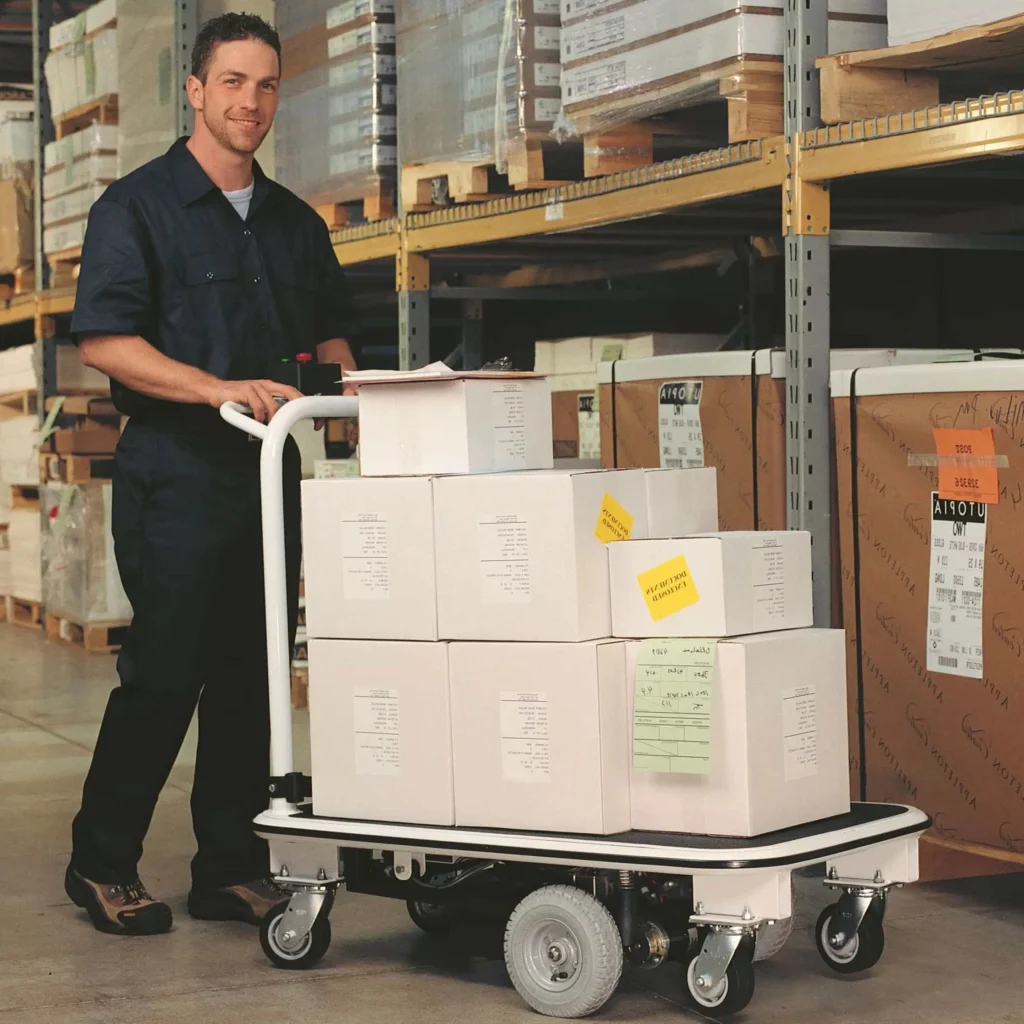
A motorized platform cart moves one heavy load on its own deck while you walk beside it, and the right one is the cart whose static deck rating clears your single heaviest load with room to spare. Turning a load weight into a real spec means pinning down capacity, deck size, deck height and drive type, then matching each rung to a named Pony Express SKU you can actually order. Heavy Duty Mobility stocks four of them, from the 1,000 lb 1040 to the 4,000 lb 1032, so the decision comes down to reading down the ladder to your number.
Last updated June 2026. Push and pull force limits and ergonomic load handling come down to your own facility's rules and the OSHA and NIOSH guidance linked at the end, so read those before you run a loaded cart up a ramp.
Our picks at a glance
- Top Pick
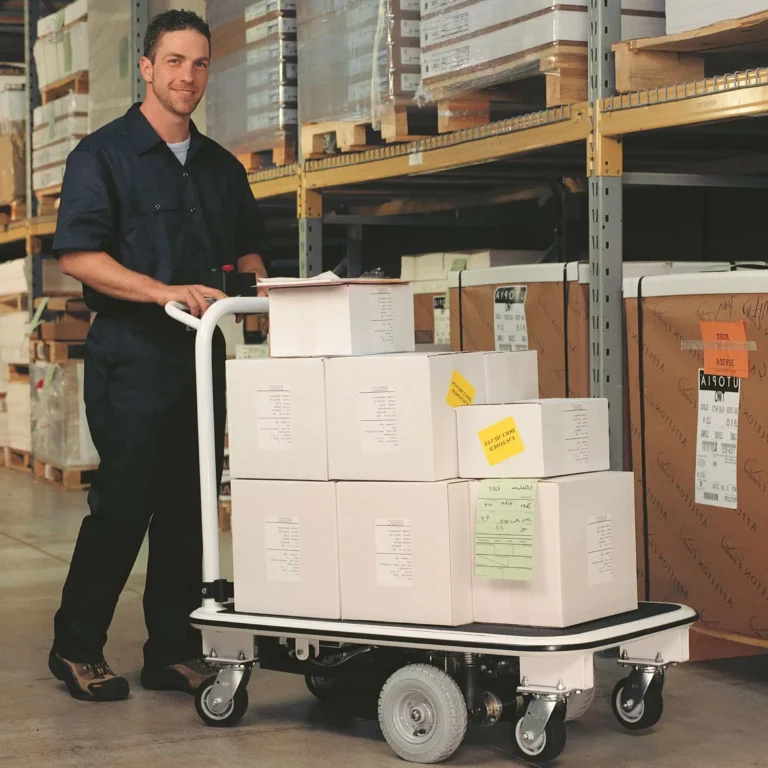 Pony Express 1031 Series Motorized Platform Carts for Loads up to 2,000 lbs$3,295View details
 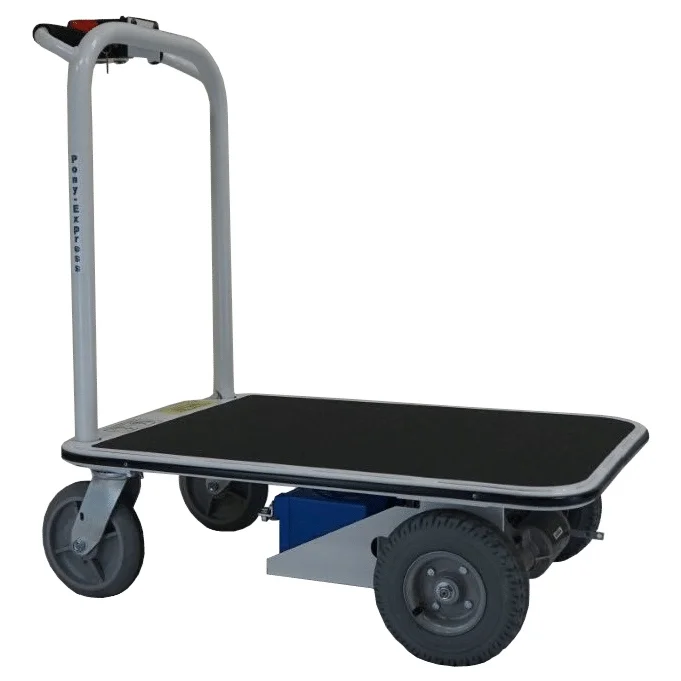 Pony Express 1040 Series Motorized Platform Carts
- Weight Capacity1000 lbs
- Platform Size (L x W)32" x 24"
- Platform Deck Height12"
$2,895View details- Pony Express 1040-E Series Motorized Platform Carts
- Weight Capacity1000 lbs
- Incline Rating at Full Load15° (1040-E)
- Platform Deck Height12"
$3,545View details 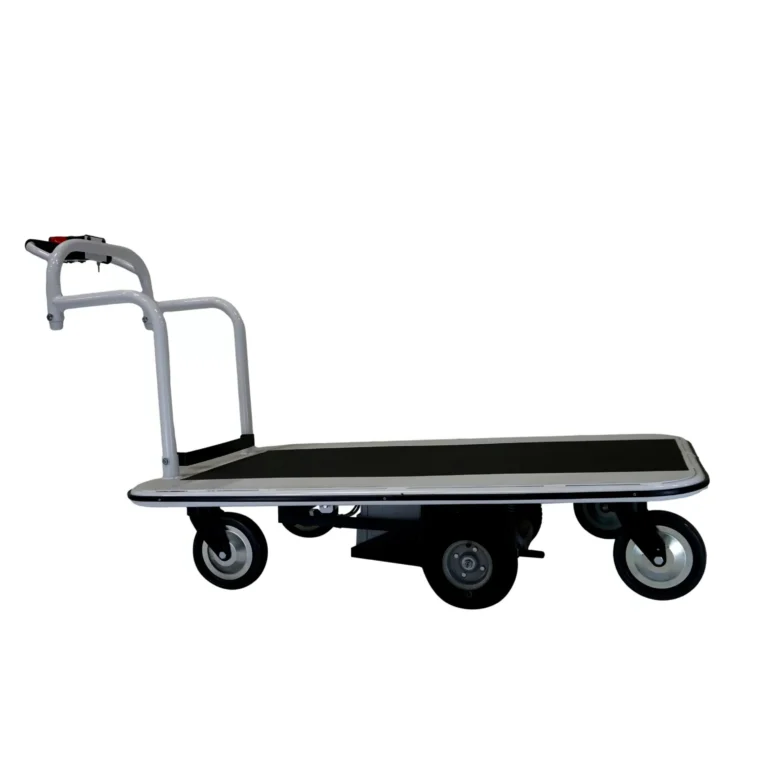 Pony Express 1032 Series Heavy-Duty Motorized Platform Carts for Loads up to 4,000 lbs
- Weight Capacity3000 lbs or 4000 lbs
- Usable Platform (W x L)34.5" x 52"
- Platform Deck Height11.5"
$6,299View details
How do you choose a motorized platform cart by load capacity?
To choose a motorized platform cart by load capacity, weigh your single heaviest load on a flat floor, then pick the lightest rung of the capacity ladder that still clears that weight with margin to spare. That one number, the static deck rating, anchors the whole decision. Everything else - deck size, deck height, drive type - rides on top of it.
Start with the load, not the cart. Put your heaviest pallet, cage or fixture on a scale and use that real figure. A guess rounds the wrong way. The published capacity on each cart is a static rating, meaning the maximum weight the deck and casters hold while the powered cart drives itself across a level floor with the load sitting on the platform.
Then rate the cart above the load. If your load runs 1,800 lb, the 2,000 lb class is too close to the ceiling once you factor in an uneven deck, a second item someone sets on top, or a battery near the end of its life. Step up to the rung that gives you headroom. Running a cart at its exact limit every shift is how decks bow and brakes wear early.
Here is the Pony Express ladder you are matching to, in weight order. The 1040 carries 1,000 lb on a flat floor. The 1040-E carries the same 1,000 lb but climbs a 15 degree incline fully loaded. The 1031 covers 1,500 to 2,000 lb across its sub-models. The 1032 tops the platform line at 3,000 or 4,000 lb. One gap is worth naming up front. The platform line skips the 2,000 to 3,000 lb band, so a load in that range steps up to the 3,000 lb 1032 rather than sitting on the 1031. Weight gets you to the right rung. The next three sections cover deck size, deck height and drive or incline so you spec the rest of the cart right too.
What does the weight capacity on a motorized platform cart actually mean?
Weight capacity on a motorized platform cart is the static rating for one load resting on its own deck. It is not a towing figure and not a per-caster number, so you size it against the full weight of the single load you set on top. A 2000lb motorized platform cart carries up to 2,000 lb on the deck itself, period.
This is where a platform cart and a tugger part ways. A platform cart is the carry tool - the load sits on its deck and rides along. An electric tugger is the pull tool - it tows wheeled carts behind a hitch and is rated by pull force on a flat floor, not by deck load. If you are moving one heavy item, you want a platform cart. If you are pulling a train of several wheeled carts at once, that is a tugger job, which we cover below.
Weigh the load and add margin for the same reason every time. Rate the cart above the real load so an uneven deck, a partial second item, or a worn battery never runs the cart at its ceiling. A heavy duty motorized cart that spends its life at 100 percent of rating is a cart you replace early.
One more thing the published number assumes - a flat floor. The static rating is measured on level ground. The moment a ramp or grade enters the route, usable capacity drops, because the drive has to fight gravity as well as carry the load. That is exactly why the incline-rated 1040-E exists as a separate rung rather than a footnote on the 1040.
Watch the model names too. One model name can hold several ratings. The 1031 spans a 1,500 lb and a 2,000 lb build across its sub-SKUs, named down to the 1031-S2000 and the 1031-HD. The 1032 splits into a 3,000 lb 1032-3000 and a 4,000 lb 1032-4000. When you spec by load, you are really specing to a sub-model, so your weight points you to a specific build rather than just a model name.
Which motorized platform cart matches my load weight?
Match your load weight to the lightest cart that clears it - the 1040 and 1040-E for single loads up to 1,000 lb, the 1031 for 1,500 to 2,000 lb, and the 1032 for 3,000 or 4,000 lb single loads. Read down to your number and stop at the first rung that covers it with margin. If your load lands between 2,000 and 3,000 lb, the platform line jumps that band, so you step up to the 3,000 lb 1032.
- Up to 1,000 lb, flat floor1,04024 in by 32 in deck, 12 in height, level floors only
- Up to 1,000 lb, with a ramp1040-EClimbs 15 degrees fully loaded, 44 Ah battery, up to 10 miles of run
- 1,500 to 2,000 lb1,031Center wheel drive, 11.5 in deck, the common warehouse and healthcare rung
- 3,000 or 4,000 lb1,03234.5 in by 52 in deck, 11.5 in height, center wheel drive
Up to 1,000 lb on a flat floor is the 1040. Its usable deck is 24 in wide by 32 in long at a 12 in deck height, and it runs 8 hours on a 35 Ah AGM battery. This is the pick when the load is one pallet or one cage under 1,000 lb and every route is level. At $2,895 it is the most affordable rung.
Up to 1,000 lb with a climb is the 1040-E. Same 1,000 lb class and same 12 in deck height as the 1040, but rated to climb 15 degrees fully loaded on a larger 44 Ah AGM battery, with up to 10 miles of continuous run. Choose it when the route crosses a dock ramp or a real grade. It lists at $3,545.
1,500 to 2,000 lb is the 1031, the mid-ladder default. It rides on an 11.5 in deck with center wheel drive for a tighter turn, and it covers the widest band of common warehouse and healthcare loads on one model. At $3,295 it is the best warehouse motorized cart for most buyers, which is why it is our top pick below.
3,000 or 4,000 lb is the 1032, the top platform rung. Its deck is 34.5 in wide by 52 in long at 11.5 in height, with the same center wheel drive as the 1031 under a bigger payload. It is the pick when one load tops the 2,000 lb 1031, anywhere from a 3,000 lb build up to its 4,000 lb ceiling. It lists at $6,299.
Then the ladder ends. Once a single load tops 4,000 lb, or the job is pulling several wheeled carts in a train rather than carrying one on a deck, the answer is an electric tugger like the Pony Express AC Tugger 25K+, rated to move up to 25,000 lb of rolling load. A tugger is a different tool with a different price class, so reach for it only when the platform line genuinely runs out.
Raphael's rule of thumb If your heaviest load lands within 200 lb of a rung's ceiling, buy the next rung up. Stepping from the $3,545 1040-E to the $3,295 1031, or from the 1031 to the $6,299 1032, costs less than a bowed deck and a service call eighteen months in, and the bigger cart simply does not care about the lighter loads.
Motorized platform cart comparison by load capacity
This table lines up all four Pony Express platform carts so you can match a load weight to a deck size, deck height and drive type at a glance. Two patterns are worth calling out before you read it.
Pony Express motorized platform cart comparison by load capacity
| Model | Weight Capacity | Usable Deck (W x L) | Deck Height | Drive / Incline | Price |
|---|---|---|---|---|---|
| Pony Express 1040 | 1000 lbs | 24" x 32" | 12" | Flat floor, no incline rating | $2,895 |
| Pony Express 1040-E | 1000 lbs | 24" x 32" | 12" | 15 degrees at full load (1040-E) | $3,545 |
| Pony Express 1031 | 1,500 to 2,000 lbs (1031-S / 1031-HD) | 25.5" to 34.5" wide x 40" to 61" long | 11.5" | Center wheel drive | $3,295 |
| Pony Express 1032 | 3000 lbs or 4000 lbs | 34.5" x 52" | 11.5" | Center wheel drive | $6,299 |
First, the deck height steps down as capacity goes up. The 1,000 lb 1040 family sits at a 12 in deck, while the heavier 1031 and 1032 drop to 11.5 in. A lower deck is easier to load by hand and clears a low doorway or elevator car with the load on board. Second, the heavy rungs change how they steer - the 1031 and 1032 run center wheel drive for a tighter turn, while the 1040 family runs the flat-floor or incline build. The 1031 row carries its full sub-SKU range in one cell, from 25.5 in to 34.5 in wide and 40 in to 61 in long, so the table stays clean while the prose keeps the detail. Speed is identical across all four at 0 to 1.5 mph low and 0 to 3 mph high, because every one of these is a walk-beside cart, not a ride-on machine.
How do you size the deck on a motorized platform cart?
Size the deck by the footprint of your load, not just its weight, so the load sits fully on the platform with the wrap-around bumpers protecting it rather than hanging over the edge. Measure the longest and widest point of your load, then pick a deck that contains it. An overhanging load shifts the center of gravity and loses the bumper protection the cart is built to give.
- 1040 / 1040-E base24" W x 32" L12 in deck height, level or incline build
- 1031 range25.5" to 34.5" W x 40" to 61" L11.5 in deck height across 1031-S through 1031-HD
- 103234.5" W x 52" L11.5 in deck height, 3,000 or 4,000 lb build
Here are the deck footprints across the line. The 1040 and 1040-E base at 24 in wide by 32 in long. The 1031 ranges from 25.5 in to 34.5 in wide and 40 in to 61 in long across its sub-models. The 1032 is fixed at 34.5 in wide by 52 in long. If your load is a standard 48 in pallet, none of the base decks contain it lengthwise, which is exactly why the longer sub-models exist.
That sub-model logic is worth understanding, because the same family scales up in length on the same deck height. Inside the 1031 line, a 1031-S runs 40 in long, a 1031-M runs 49 in and a 1031-L runs 61 in, all on the same 11.5 in deck. The 1040-E family scales the same way, from the 24 in by 32 in base up to a 34.5 in by 52 in 1040-HDE. So when you spec a motorized flatbed cart deck size, you are picking both a width and a length within a family, not just a model name.
Deck height matters as much as deck area for two jobs - loading and clearance. The 1040 family sits at 12 in and the 1031 and 1032 at 11.5 in. A lower deck is less of a lift when you load by hand, and that half-inch can be the difference between clearing a low doorway or an elevator car with the load already on board. Measure your tightest opening before you commit to a deck.
The deck surface itself is the same story across the family, so it is not a decision axis. Non-skid platform surface, curved corners and full wrap-around vinyl bumpers come standard on every model. The deck spec is about fit and clearance, not about whether the load stays put. Browse the full motorized platform cart lineup from 1,000 lb to 4,000 lb if you want to compare every deck length side by side.
Do you need an incline-rated motorized platform cart?
You need an incline-rated cart like the 1040-E whenever the route includes a dock ramp or any real grade, because the standard 1040 is built for level floors and its flat-floor capacity drops on a slope. If the load ever crosses a ramp, the flat-floor 1040 is the wrong pick and the 1040-E is the rung built for it.
What the 1040-E adds over the 1040 is specific. It carries a 15 degree incline rating at full load, runs a larger 44 Ah AGM battery against the 1040's 35 Ah, and is designed for up to 10 miles of continuous operation. Same 1,000 lb class, same 12 in base deck, but built to keep its footing on grade where the standard cart is not.
There is one detail worth pulling from the spec grid. Within the 1040-E family, the longest deck, the 1040-LE, is rated to climb 12 degrees rather than 15, while the other 1040-E builds hold the full 15 degree rating. So if your route has both a steep ramp and a long load, check the exact sub-model, because the longest deck trades a little climb for its length.
Braking is the safety half of incline use, and it comes standard. Regenerative dynamic braking controls speed while the cart is moving, and an automatic electromagnetic holding brake parks the loaded cart on a slope so it does not roll when you stop. That holding brake is what makes a powered cart on a ramp safer than a manual one, where a slip means the operator is the brake.
If every route in your building is level, do not pay for incline. The standard 1040 covers the same 1,000 lb class for several hundred dollars less, and the incline rating is capability you would never use. Buy the climb only when the floor plan actually has a grade.
Why does drive type matter on a heavy platform cart?
Drive type matters because center wheel drive on the 1031 and 1032 gives a tighter turning radius than front wheel drive, which is what lets a 2,000 to 4,000 lb load still turn inside a crowded warehouse or hospital aisle. Center wheel drive pivots the cart closer to its own center, so the heavy rungs of the ladder fit tight aisles a front wheel drive cart would fight.
It is no accident the center wheel drive shows up on the heavy rungs. The 1031 and 1032 carry the most weight and most often work in the most congested space - a packed warehouse aisle, a hospital corridor with carts and people. Pairing the tighter turn with the higher capacity is the point. A heavy load you cannot steer around a corner is not actually movable.
The tires back up the maneuvering. Foam-filled, puncture-proof, non-marking drive tires run across the whole family, which means no flats to strand a loaded cart mid-shift and no black scuffs on a finished floor. The drive spec here is about maneuvering and uptime, not just traction off the line.
For durability context rather than the headline - the chassis is powder-coated welded steel and the operating range runs from -40 to +70 degrees C, so the same drive works in a cold loading dock and a hot plant floor. That is the difference between a cart that handles your whole building and one that only likes the comfortable rooms.
Tie it back to the load decision. A heavier load in a tight aisle pushes you toward the center wheel drive 1031 or 1032. A light load on open floor does not need it, which is part of why the flat-floor 1040 stays cheaper. Drive type is a real axis, but it follows from where and how heavy you are working, not the other way round. You can browse every battery powered material handling cart to see how drive type shifts across the wider range.
Which motorized platform cart should most buyers start with?
Most buyers land on the Pony Express 1031 because it covers 1,500 to 2,000 lb on one model with center wheel drive, which fits the widest band of warehouse and healthcare loads on a single cart. It is the mid-ladder default for a reason - it sits right where the most common heavy loads land.
Pony Express motorized platform carts by load capacity
- #1Best overall
Pony Express 1031 Motorized Platform Carts for Loads up to 2,000 lbs
The mid-ladder default and the cart most spec-by-load buyers land on. It covers 1,500 to 2,000 lb across a deck that runs 25.5 in to 34.5 in wide by 40 in to 61 in long, so one model serves the widest band of warehouse and healthcare loads once you pick the right sub-build. Center wheel drive gives a tighter turning radius than a front wheel drive cart, which is what lets a 2,000 lb load still turn inside a crowded aisle.
See price & details- Pros
- Covers 1,500 to 2,000 lb on one model across its sub-SKUs, from the 1031-S to the 2,000 lb 1031-HD
- Center wheel drive for a tight turn under heavy load in congested aisles
- 11.5 in deck, dual 0 to 1.5 and 0 to 3 mph speeds, 35 Ah AGM battery rated 8 hours per charge
- In stock, assembled and serviced in the US
- Cons
- No incline rating, so it is a flat-floor cart like the standard 1040
- Caps at 2,000 lb, so a load between 2,000 and 3,000 lb steps up to the 1032 instead
- Sold as sub-models across the 1,500 to 2,000 lb range rather than one fixed rating
- #2
Pony Express 1040 Motorized Platform Carts
The entry rung for the 1,000 lb single-load reader on level floors. Its usable deck is 24 in wide by 32 in long at a 12 in height, and it runs 8 hours on a 35 Ah AGM battery with foam-filled non-marking drive tires. This is the default pick when the load is one pallet or one cage under 1,000 lb and every route is flat, at the lowest price on the ladder.
See price & details- Pros
- Carries up to 1,000 lb on its own deck, the entry rung of the load ladder
- Lowest price of the four at $2,895 for the 1,000 lb class
- 24 in by 32 in deck at a 12 in height, easy to load by hand
- Foam-filled puncture-proof non-marking drive tires rated for 8 hours on a 35 Ah AGM battery
- Cons
- Flat floor only, with no incline rating, so it is the wrong pick for any route with a ramp
- 1,000 lb ceiling, so a heavier single load steps up to the 1031 or 1032
- #3
Pony Express 1040-E Motorized Platform Carts
The incline-rated rung in the 1,000 lb class. Same 1,000 lb capacity and 12 in base deck height as the 1040, but rated to climb 15 degrees fully loaded on a larger 44 Ah AGM battery, with up to 10 miles of continuous run. This is the cart for a route that crosses a dock ramp or a real grade rather than a flat floor.
See price & details- Pros
- Carries the full 1,000 lb class up a 15 degree incline fully loaded on most builds in the family
- Larger 44 Ah AGM battery and up to 10 miles of run
- Regenerative dynamic braking plus an automatic electromagnetic holding brake for slope safety
- Deck scales up the 1040-E family from 24 in by 32 in to 34.5 in by 52 in
- Cons
- Built for grade, so the incline rating is capability a flat-floor route never uses
- The longest 1040-LE deck is rated to 12 degrees rather than 15
- #4
Pony Express 1032 Heavy-Duty Motorized Platform Carts for Loads up to 4,000 lbs
The top of the platform-cart ladder for the heaviest single loads. Models rated 3,000 lb or 4,000 lb on an 11.5 in deck measuring 34.5 in wide by 52 in long, with the same center wheel drive as the 1031 for tight turns under a big payload. This is the pick when one load tops the 2,000 lb 1031 but a tugger pulling multiple carts is not yet warranted.
See price & details- Pros
- Top platform capacity at 3,000 lb or 4,000 lb on one fixed deck
- 34.5 in by 52 in deck at 11.5 in height for large single loads
- Center wheel drive for a tight turn under the heaviest payload
- Dual 0 to 1.5 and 0 to 3 mph speeds in forward and reverse
- Cons
- Largest and heaviest of the four, so it is more cart than a sub-1,000 lb load needs
- Above 4,000 lb on one load, or for pulling a train of carts, you need an electric tugger instead
The case for the 1031 is its range on one model. It covers 1,500 to 2,000 lb across a deck that runs 25.5 in to 34.5 in wide by 40 in to 61 in long, so one model name serves most common loads once you pick the right sub-build. It rides an 11.5 in deck with center wheel drive for the tighter turn, runs dual 0 to 1.5 and 0 to 3 mph speeds, holds 8 hours per charge on a 35 Ah AGM battery, ships in stock and is assembled and serviced in the US.
It is also the SKU the most-asked search lands on. The 2000lb motorized platform cart query maps straight to the 1031, so the load most buyers are weighing is the load this cart was built around. At $3,295 it sits between the lighter 1040 and the heavier 1032, which is where most spec-by-load readers end up.
Point yourself off the default only if your load tells you to. For a single load under 1,000 lb, the 1040 or 1040-E is the cheaper, lighter answer. When one load tops the 2,000 lb 1031, step up to the 1032 at 3,000 or 4,000 lb. The 1031 is the start point, not the only answer.
One off-ramp worth naming. If the load is medical gas cylinders rather than a flat deck of goods, the purpose-built EK Tech Pony Express Motorized Medical Gas Cylinder Cart holds cylinder racks instead of a flat platform and is the right tool over any general platform model. Match the cart to the cargo, not just the weight.
Where to go next
Once you know your single-load weight, your deck footprint and whether the route has a ramp, the next step is comparing prices and sub-models inside the right capacity class. Start with the full motorized platform cart lineup from 1,000 lb to 4,000 lb to see every rung and sub-build in one place.
If your loads are lighter office and mailroom work, look at the lighter motorized mailroom and utility carts for office floors instead. If you want the widest view, browse every battery powered material handling cart. Once you have your model picked, our guide to picking the right battery for a motorized cart or tugger walks through AGM capacity and run time so you spec the power pack right too.
Frequently asked questions
How do you choose a motorized platform cart by load capacity?
Weigh your single heaviest load on a flat floor, then pick the lightest rung of the capacity ladder that still clears that weight with margin. The published capacity is a static deck rating, so size it against the full weight of one load on the platform. The Pony Express ladder runs 1,000 lb on the 1040, 1,000 lb with a 15 degree climb on the 1040-E, 1,500 to 2,000 lb on the 1031 and 3,000 or 4,000 lb on the 1032. A load between 2,000 and 3,000 lb steps up to the 1032. Rate the cart above the real load so a partial overload, an uneven deck or a worn battery never pushes it to its limit.
What is a 2000lb motorized platform cart?
A 2000lb motorized platform cart carries up to 2,000 lb of single load resting on its own powered deck. In the Pony Express line that is the 1031, which spans 1,500 to 2,000 lb across its sub-models on an 11.5 in deck with center wheel drive, topping out at the 2,000 lb 1031-HD. It lists at $3,295 and ships in stock. The 2,000 lb figure is a static deck rating on a flat floor, not a towing number, so it applies to one load sitting on the platform rather than carts pulled behind a hitch.
What deck size do I need on a motorized flatbed cart?
Measure the longest and widest point of your load and pick a deck that contains it, so the load sits fully on the platform with the bumpers protecting it rather than overhanging. The 1040 and 1040-E base at 24 in wide by 32 in long. The 1031 ranges from 25.5 in to 34.5 in wide by 40 in to 61 in long across its sub-models, and the 1032 is 34.5 in wide by 52 in long. An overhanging load shifts the center of gravity, so size the deck up rather than letting cargo hang off the edge.
What is the difference between a motorized platform cart and an electric tugger?
A platform cart carries one load on its own deck and is rated by static deck capacity. An electric tugger tows wheeled carts behind a hitch and is rated by pull force on a flat floor. Use a platform cart when you are moving a single heavy item, up to the 4,000 lb 1032. Move to a tugger like the Pony Express AC Tugger 25K+, rated to move up to 25,000 lb of rolling load, once a single load tops the platform ceiling or the job is pulling several carts in a train.
Can a motorized platform cart climb a ramp?
Only an incline-rated model should be driven up a ramp under load. The standard 1040 is built for level floors, and its flat-floor capacity drops on a slope. The 1040-E is rated to climb 15 degrees at full load on a larger 44 Ah AGM battery, with up to 10 miles of run. Within that family the longest 1040-LE deck is rated to 12 degrees rather than 15. Regenerative dynamic braking and an automatic electromagnetic holding brake keep the loaded cart from rolling when you stop on a grade.
How fast does a motorized platform cart go?
Every Pony Express platform cart runs two speed ranges, 0 to 1.5 mph on the low setting and 0 to 3 mph on the high setting, in forward and reverse. The speed is set to match a normal walking pace because these are walk-beside carts you control from an ergonomic thumb-wheel handle, not ride-on machines. The 1040, 1040-E, 1031 and 1032 all share the same speed range, so capacity and deck size are the specs that change as you go up the ladder, not top speed.
Sources & references
- OSHA - Ergonomics and reducing musculoskeletal injury from manual push and pull force Authority
- CDC NIOSH - Ergonomic guidelines for manual material handling (pushing, pulling and carrying loads) Authority
- EK Tech Pony Express 1031 motorized platform cart spec sheet (Heavy Duty Mobility product specifications)
- EK Tech Pony Express 1032 heavy-duty motorized platform cart spec sheet (Heavy Duty Mobility product specifications)